
 CelebYachts reportInvestigations
The three-hull limit of the United Arab Emirates registry
The flag state holds only three superyachts because its regulatory framework lacks the published transparency of larger open registers, forcing owners to…
By On the record · Aug 12, 2026 · Data from CelebYachts1
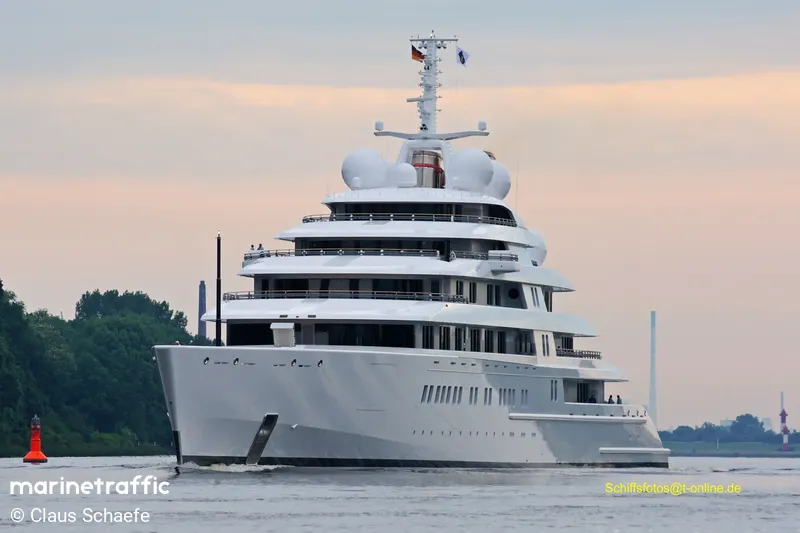
A vessel’s position is the boat’s, not the owner’s. Ownership is as reported, not certified.
The United Arab Emirates maritime register contains exactly three vessels. Their selection reveals a deliberate choice to anchor in a jurisdiction defined by geographic convenience rather than the tax or crewing advantages that drive the wider open registry market.
The United Arab Emirates maritime register contains exactly three superyachts. Their presence on the ledger reflects a calculated decision to anchor in a jurisdiction defined by geographic convenience rather than the tax or crewing advantages that drive the wider open registry market. When an owner selects this flag, they accept a smaller peer group and a less transparent administrative framework in exchange for proximity to regional infrastructure. The arithmetic of the register confirms that the choice is niche, reserved for vessels that require immediate access to the Persian Gulf and the Arabian Sea without navigating the bureaucratic friction of distant European or Caribbean offices.
The arithmetic of a closed book
The registry holds three hulls, representing one percent of the tracked fleet. The distribution skews heavily toward the upper echelon of the market. Azzam measures 180.61 metres, establishing her as the longest vessel under this flag. Dubai follows at 160.0 metres, while Dubawi sits at 88.3 metres. The spread between the largest and smallest hull exceeds ninety-two metres, indicating that the flag does not cater to a single segment of the charter or private market. Instead, it accommodates distinct operational profiles that happen to converge on the same administrative office.
Public records do not disclose the total annual revenue generated by these registrations, nor do they publish the specific tonnage tax brackets applied to vessels flying the Emirati ensign. The sale price of any of the three hulls remains unverified, and the corporate structures behind their ownership are not filed in open maritime databases. Because the details have not been published, the exact financial incentive for choosing this flag over a more established open registry cannot be quantified. The move after the silence is always the same: turn to the constraint you can describe. Volume, beam, the position of the machinery, the deck the helicopter takes, what the classification demands. Those are facts about the inside of a boat that do not require a floor plan.
The mechanics of an opaque ledger
International law requires that every merchant ship be registered in a country, and the country in which a ship is registered becomes its flag state. A ship operates under the laws of its flag state, and these laws govern admiralty cases and safety certifications. Owners frequently select a foreign jurisdiction to reduce operating costs, avoiding higher taxes in their home country and bypassing national labour regulations that protect mariners. The modern practice of registering ships in a foreign country originated in the United States during World War I, when shipowners sought economic advantage through Panamanian registration. The term flag of convenience entered common usage by the 1950s, describing vessels registered in countries with few questions asked and minimal residency requirements for owners.
Traditional maritime nations responded to this shift by creating second registers. The Isle of Man launched its registry in 1984, followed by Norway, the Netherlands, France, and Germany. These secondary flags offered online registration and cheaper foreign labour while maintaining a link to established European legal systems. The United Arab Emirates registry operates outside this historical lineage. It functions as a direct national register rather than a parallel offshore entity, which means it does not advertise the same level of procedural flexibility found in Panama or Liberia. port state control inspections remain the primary enforcement mechanism. Member states of the Paris Memorandum of Understanding on port state control conduct regular surveys covering Safety of Life at Sea and pollution prevention. Deficiencies recorded during these inspections can lead to detentions, regardless of the flag state’s internal paperwork.
The absence of published crewing quotas or explicit tax exemptions in the UAE register forces observers to rely on standard maritime conventions. The principle that a genuine link must exist between a ship’s owners and its flag state dates back to the 1958 Geneva Convention on the High Seas. Article 5 required that the state effectively exercise jurisdiction over administrative, technical, and social matters. The 1982 United Nations Convention on the Law of the Sea repeated this requirement, yet the 1986 United Nations Convention for Registration of Ships, which would have mandated economic stakes or local mariner provision, has never entered into force. Consequently, the UAE registry relies on baseline international standards rather than a bespoke legislative framework designed specifically for luxury yacht operations.
Regional anchorage
The practical utility of the Emirati flag becomes clear when examining the operational geography of the three hulls. Dubai serves as a critical logistical hub for the region. During the joint American–Israeli attack on Iran on 28 February 2026, multiple commercial vessels cancelled Middle Eastern itineraries. Celestyal Discovery, a cruise ship docked in Dubai, saw its Arabian winter season cut short. The vessel remained in port until the Persian Gulf route stabilised enough to permit transit. It departed via the newly reopened Strait of Hormuz on 17 April 2026. This sequence demonstrates the vulnerability of regional waters and the necessity of having a registered base that maintains active port authority coordination during geopolitical disruptions.
Yacht owners selecting the UAE flag gain immediate access to this coordinated port infrastructure. They do not need to establish a new relationship with local harbour masters or navigate unfamiliar customs procedures upon entering the Gulf. The administrative continuity provided by a domestic registry translates directly into operational resilience. When regional tensions spike, vessels already cleared under the local flag face fewer bureaucratic hurdles than those arriving on temporary visas or foreign registrations. The three hulls in the register benefit from this standing arrangement. Their lengths dictate different maintenance schedules, but their shared flag ensures they all report to the same survey authority and utilise the same emergency response channels.
The disparity in hull size among the three vessels further explains the limited appeal of the registry. Azzam at 180.61 metres and Dubai at 160.0 metres sit at opposite ends of the global superyacht spectrum. Dubawi at 88.3 metres operates in a completely different logistical bracket, requiring far less infrastructure but still benefiting from the same streamlined customs clearance. The registry does not specialise in either extreme; it simply provides a single point of contact for both. This dual capability prevents the register from becoming a monolithic bloc, but it also stops it from achieving the critical mass seen in larger open flags.
The United Arab Emirates register will likely remain a three-vessel cohort unless the published regulatory environment shifts. Open registries grow by advertising specific advantages: faster transfers, lower annual levies, or explicit crewing exemptions. The Emirati office offers none of these in publicly accessible documents. It offers proximity instead. For owners whose primary operating area spans the Red Sea, the Arabian Sea, and the Mediterranean, that proximity outweighs the theoretical savings of a distant jurisdiction. The register stays small because it trades scale for stability, a calculation that suits a handful of large hulls but does not attract the broader market seeking maximum administrative distance from their home ports.
Reporting and data: CelebYachts, republished by On the record.
Sources
The numbers on this page point here. Each one links to the record it came from.
- 1