
 CelebYachts reportInvestigations
The volume trap
Gross tonnage measures enclosed space, not length or displacement. The longest yacht on our register ranks third in weight, while the record belongs to a…
By On the record · Sep 17, 2026 · Data from CelebYachts1
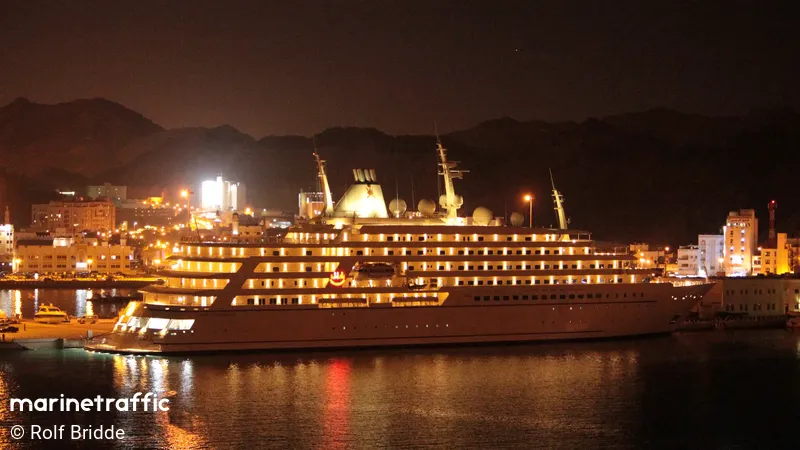
A vessel’s position is the boat’s, not the owner’s. Ownership is as reported, not certified.
The heaviest hulls by gross tonnage reveal a structural hierarchy that length alone cannot explain. Passenger safety conventions, yard capacity limits, and evolving measurement standards determine who tops the table.
Gross tonnage measures enclosed space, not mass or length. The distinction matters because the longest vessel in our register, REV OCEAN, ranks third in volume. At 182 metres she carries 16,854 gt, trailing two hulls that are significantly shorter. The record for highest gross tonnage belongs to Fulk Al Salamah, which registers 20,361 gt despite measuring just 164 metres overall. Length does not dictate volume; internal arrangement does. A ship designed as a passenger ferry will carry more air than a warship or a performance cruiser of identical dimensions. The metric rewards deck count, beam, and public accommodation over sheer scale. This explains why the top of the table is dominated by conversions and layouts prioritising habitable area rather than speed or range. The register contains 230 hulls, and the distribution reveals a sharp break point past the 14,000 gt mark. Only six vessels breach that threshold, leaving the remaining 224 to compete in a much denser band below.
The auxiliary advantage
Fulk Al Salamah was built in 2016 at T. Mariotti in Genoa. The yard constructed her as a luxury cruise ship before she entered service as a state yacht for the Sultanate of Oman. Her 20,361 gt places her 3,507 gt ahead of the next closest competitor. The margin exists because she was engineered from the keel up to carry passengers across long distances, requiring extensive internal volume for cabins, dining, and circulation spaces. When transferred to private ownership, the underlying architecture remained intact. The hull form and subdivision were dictated by maritime safety conventions for passenger vessels, which mandate higher freeboard and wider beams than those used for private cruising. That structural requirement translates directly into gross tonnage. The estimated value of $500,000,000 reflects the cost of outfitting an existing platform rather than designing a new one from scratch. The registration data shows no builder listed for the second-ranked REV OCEAN, but the absence of a name does not obscure the engineering difference between a research vessel and a passenger liner. REV OCEAN’s 16,854 gt confirms that even a dedicated oceanographic platform cannot match the volume generated by a certified passenger layout.
The Lürssen cluster
Beyond the auxiliary outlier, the heaviest private yachts cluster tightly between 155 and 160 metres. Dilbar, delivered by Lürssen in 2016, holds 15,917 gt. Al Saïd, also a Lürssen project completed in 2008, records 15,850 gt. Blue, launched in 2022, reaches 14,785 gt. These three vessels share a common constraint: they were built within the physical limits of Lürssen’s facilities in Kiel and Papenburg. The yard’s slipways and dry docks dictate maximum beam and length, forcing designers to stack volume vertically rather than spread it horizontally. Each additional deck adds roughly 1,000 to 1,500 gt, depending on interior fit-out. The progression from Al Saïd to Dilbar demonstrates how incremental changes in superstructure height and internal partitioning can shift a hull by several thousand tons without altering the waterline. Azzam, at 180.61 metres, sits further down the ranking at 13,136 gt. Her slender profile and low freeboard, optimised for high-speed passage, sacrifice internal volume for hydrodynamic efficiency. The trade-off is visible in the numbers: length gains do not compensate for reduced beam and fewer decks. Other Lürssen projects follow the same pattern. Opera, completed in 2023, measures 146.35 metres and carries 12,518 gt. A+, delivered in 2012, runs 147.25 metres with 12,532 gt. Sailing Yacht A, built by Nobiskrug in 2017, reaches 142.81 metres and 12,558 gt. The near-identical tonnage across these three hulls, despite differing lengths and yards, indicates a shared ceiling imposed by classification rules and propulsion machinery volume. The engine rooms of modern diesel-electric yachts consume a fixed percentage of the underwater hull, leaving the upper works to compete for the remaining tonnage allowance. Blohm+Voss approaches the problem differently. Eclipse, finished in 2010, measures 162.5 metres and registers 13,564 gt. Dubai, delivered in 2006 after a refit by Platinum Yachts, spans 160 metres and holds 12,488 gt. Both vessels prioritise length over vertical stacking, resulting in lower gross tonnage relative to their overall size. The architectural choice is deliberate: longer waterlines reduce wave-making resistance, but they require wider beams or additional decks to recover lost volume. Neither yard chose to widen the beam beyond practical harbour limits, so the tonnage remains capped.
The historical baseline
Older vessels registered in the same cohort operate under entirely different volume standards. El Mahrousa, originally laid down in 1865 by Samuda Brothers in London, measures 145.72 metres and carries 4,560 gt. The discrepancy is not a reflection of craftsmanship but of measurement convention. Modern gross tonnage calculations include all enclosed spaces above the main deck, whereas nineteenth-century registries often excluded certain areas or applied different multipliers. The oldest entries in the register, spanning from the late nineteenth century through the interwar period, rarely exceed 1,500 gt regardless of their length. Nahlin, built by John Brown & Co in 1930, displaces considerable steel but registers just 1,377 gt. Savarona, constructed by Blohm & Voss in 1931, reaches 124 metres and holds 4,701 gt. The jump from these early hulls to the contemporary leaders represents a fundamental shift in how yachts are conceived. Today’s largest volumes are achieved through modular construction and expanded public spaces, not through heavier plating or deeper ballast tanks. The register contains 230 hulls, and the gap between the top five and the rest of the field widens sharply past the 14,000 gt threshold. Only six vessels breach that line. The remaining fleet operates within a compressed range where length and tonnage diverge completely.
Reporting and data: CelebYachts, republished by On the record.
Sources
The numbers on this page point here. Each one links to the record it came from.
- 1CelebYachtsCelebYachts: The volume trap