
 CelebYachts reportInvestigations
The Weser pivot at Abeking & Rasmussen
Geography and a 1981 cost review forced the yard away from small wooden craft and into naval contracts and superyachts, leaving a five-boat book defined by shared draught limits and composite engineering.
By On the record · Oct 1, 2026 · Data from CelebYachts1
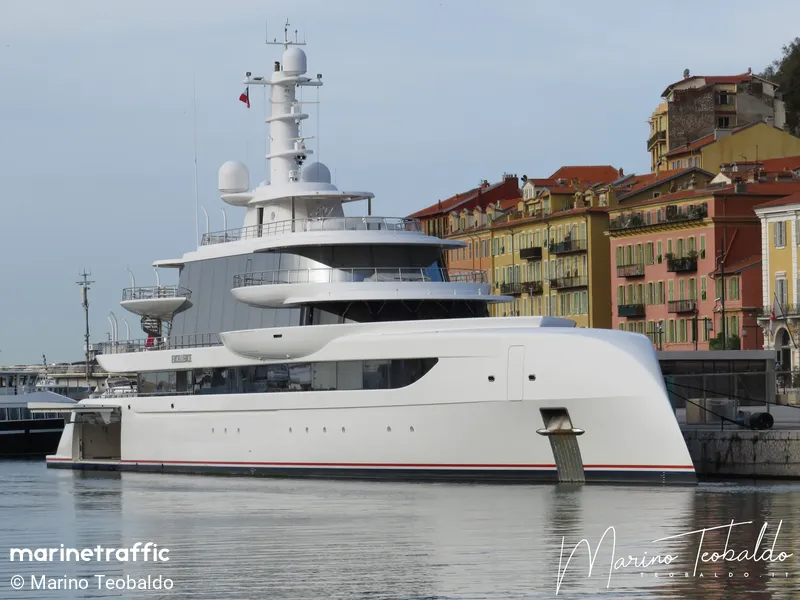
A vessel’s position is the boat’s, not the owner’s. Ownership is as reported, not certified.
Founded in 1907 on the River Weser, Abeking & Rasmussen survived by abandoning the leisure market for patrol vessels and pioneering small-waterplane-area twin hull designs. Its current superyacht output reflects those naval roots, constrained by the river’s depth and the dimensions of its Lemwerder sheds.
Abeking & Rasmussen operates at a specific scale because its location on the River Weser and a strategic retreat from small craft in 1981 eliminated lower-margin production lines. The yard now builds vessels that fit its existing sheds, navigate the tidal river, and satisfy buyers who require proven stability systems and discrete luxury fittings. Its five registered hulls demonstrate how a century-old German shipyard adapts to modern economics by merging naval engineering with superyacht commissioning.
The river and the ledger
The yard sits on the left bank of the River Weser at Lemwerder, directly opposite Vegesack in Lower Saxony. This position dictates everything from delivery routes to maximum beam. The river provides a natural dry-dock environment, but its tidal range and channel width cap the size of vessels that can reach the slipways without extensive dredging. The facility compensates with an inner harbour and a syncrolift, allowing hulls to be moved between production halls and workshops without relying solely on waterborne transit.
Georg Abeking and Henry Rasmussen established the business in 1907 with backing from the Grand Duke of Oldenburg, a sailing enthusiast who understood the commercial potential of the site. Rasmussen brought practical design experience to the partnership; he idolised the American naval architect Nathanael Herreshoff and had already built his own 5-metre class racing yacht, Frisia, before the yard opened its doors. That early focus on performance sailing craft set a template that lasted decades. By 1928, the yard was building Starling Burgess Atlantic one-designs, exporting finished hulls to the United States when post-war European manufacturing offered a price advantage over domestic American builders.
The financial logic of shipbuilding changed after the second world war. The yard continued to construct patrol boats and specialised commercial vessels alongside private yachts, maintaining a dual track that separated naval engineering from luxury fitting. The turning point arrived in 1981, when internal cost–benefit analysis concluded that constructing smaller yachts was no longer economically viable. The yard stopped building varnished wooden hulls, cutting the line on the 11.4-metre sailing yacht Barbarella. From that year forward, the business concentrated exclusively on the superyacht sector and naval contracts, a strategic narrowing that removed low-margin work and forced the remaining production lines to justify their overhead through higher gross values.
The superyacht book
The yard’s current register holds five completed hulls, spanning twenty-two years of intermittent production. The total length of these vessels is 376.1 metres, with the longest being Aviva, delivered in 2017 at 98.4 metres. The other four measure 79.95 metres, 73.52 metres, 72.25 metres, and 52.0 metres. They were completed in 2019, 2018, 2016, and 1997 respectively.
This spread reveals a deliberate sizing strategy rather than a random collection of commissions. Four of the five hulls fall within the 70-to-80-metre band, which aligns with the standard dimensions of large European production sheds and the deck strength required for heavy machinery. The outlier, Aviva, breaks that pattern at nearly 100 metres, requiring reinforced framing and a wider berth at the quay. The smallest, Amore Mio II, predates the modern era and reflects the earlier period when the yard still accepted mid-sized private orders before the 1981 pivot locked the operation into larger tonnage brackets.
The interiors and exact specifications of these vessels remain unpublished. What is visible in the steel is a consistent approach to volume distribution. The yard does not publish floor plans, but AIS data and public records show that each hull prioritises a long, unbroken upper deck and a recessed aft platform designed for tender deployment. The placement of the helicopter landing area on Aviva and EXCELLENCE requires reinforced deck framing, a specification common to the yard’s naval contracts.
Naval engineering and the SWATH legacy
Abeking & Rasmussen is equally recognised for its work in developing small-waterplane-area twin hull ships, a category that demands precise hydrostatic calculations and rigid cross-tie structures. The same engineering discipline that governs SWATH stability applies to the superyachts in the yard’s book. The transition from wooden planking to cold-moulded composites began in earnest during the 1990s, exemplified by the 42-metre ketch Hetairos, launched in 1993. Designed by Bruce King, the vessel features a 230-tonne centreboard constructed from African khaya and sipo mahogany, drawing 3 metres with the board retracted and 8.7 metres when deployed. While Hetairos falls outside the current superyacht register due to its length and material, it demonstrates the yard’s capacity to handle complex moving parts and heavy displacement in a compact footprint.
The decision to specialise in naval and composite work allowed the yard to amortise tooling costs across multiple projects. A single mould or CNC-cutting programme serves both a patrol boat frame and a superyacht hull section, reducing the per-unit expense of composite lay-up. The five production halls accommodate this mixed workflow, separating high-noise fabrication from precision finishing areas. Offices and administrative blocks sit adjacent to the workshops, keeping project management within sight of the slipways.
The yard’s output has slowed in recent years, with only two vessels recorded since 2016. This contraction reflects broader industry trends in German shipbuilding, where labour costs and regulatory compliance raise the baseline expenditure for every new keel. The syncrolift remains operational, but the number of active slips determines how many hulls can be parallel-built at any given time. When the yard takes on a 98-metre project like Aviva, it occupies a significant portion of its floor space for eighteen months, limiting concurrent starts.
The combination of a fixed riverfront location, a 1981 strategic retreat from small craft, and a sustained investment in naval-grade composite techniques has produced a shipyard that operates at a specific scale. It does not chase record-breaking lengths, nor does it return to wooden racing sloops. It builds vessels that fit its sheds, navigate the Weser, and satisfy buyers who require proven stability systems and discrete luxury fittings. The next hull will arrive when the slipway clears and the composite programme finishes its current cycle.
Reporting and data: CelebYachts, republished by On the record.
Sources
The numbers on this page point here. Each one links to the record it came from.
- 1