
 CelebYachts reportData
White Rabbit's regional track
AIS data shows a 61-metre steel yacht operating within fixed coastal boundaries, constrained by hull geometry and managed by an industrial family that treats…
By On the record · Aug 10, 2026 · Data from CelebYachts1
A vessel’s position is the boat’s, not the owner’s. Ownership is as reported, not certified.
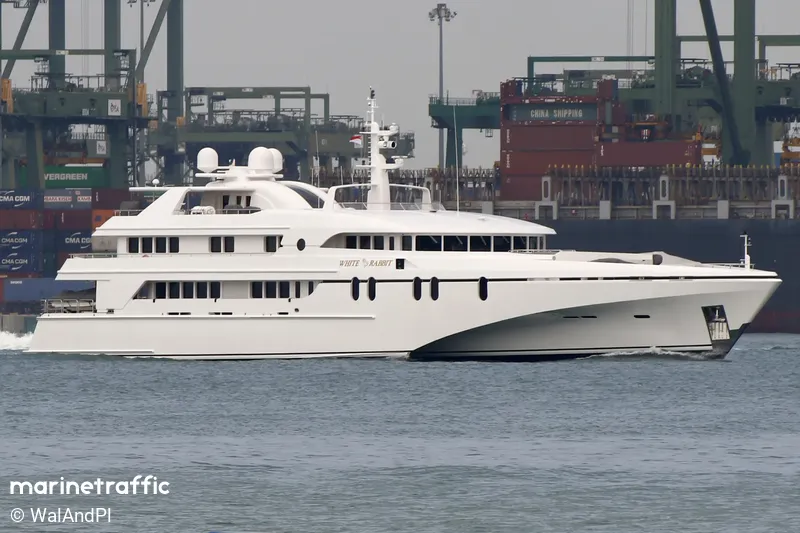
White Rabbit measures 61.45 metres and displaces 1,178 gross tonnes. Built in Tasmania in 2005, she avoids transoceanic deployment in favour of regional station-keeping. The August 2026 track reveals how engineering limits and corporate structure dictate her movements.
White Rabbit measures 61.45 metres in length and displaces 1,178 gross tonnes. She was launched in 2005 by North West Bay Ships in Tasmania. Her owner is the Goh Cheng Liang family, whose wealth stems from industrial paint manufacturing and property development. The AIS record for 2026 shows two distinct movements in August, separated by a period of silence that ends with a broadcast off the coast of Borneo. The pattern shows regional station-keeping rather than transoceanic deployment. A vessel of this proportion and age operates within a fixed radius because her design prioritises coastal stability over blue-water endurance, and her owners treat her as a functional asset rather than a global touring platform.
The Tasmanian hull
North West Bay Ships built their reputation on steel-hulled workboats and expedition vessels. They do not produce the aluminium superstructures that dominate the 60-metre class today. White Rabbit’s 15.69-metre beam relative to her 61.45-metre length gives her a ratio of roughly four to one. This proportion favours interior volume and roll damping in choppy seas, but it restricts top-end speed. The registered maximum speed recorded in our archives aligns with this geometry. She tops out at 12.1 knots. A displacement hull of this mass cannot exceed that velocity without consuming fuel at an unsustainable rate. The engine room layout, dictated by the yard’s standardised steel frames, leaves no room for high-performance shafting or twin-screw acceleration. She moves at the pace the water allows.
The gross tonnage of 1,178 places her firmly outside the megayacht category. Classification societies typically apply different safety and crewing standards above 2,000 tonnes. White Rabbit falls under the commercial regulations applicable to smaller vessels, which simplifies chartering and reduces port fees in jurisdictions that tax by tonnage. Her home port is listed as Kingston, the capital of Saint Vincent and the Grenadines. This flag state offers a lower annual levy and a streamlined registry process compared to the Cayman Islands or Malta. For an owner whose primary business is industrial coatings, the administrative overhead of a European flag would represent an unnecessary friction point. The vessel is registered, maintained, and operated within a single regulatory corridor.
The August track
Our position archive contains two complete passages for White Rabbit in August 2026. The first begins on 2 August at 02:24 UTC. The transponder activates and tracks a course toward a point 119 nautical miles off Sibu, Malaysia. The distance covered is 373.8 nautical miles. The average speed is 12.0 knots, matching the maximum speed recorded. The broadcast coverage for this leg is nine percent. Nine percent means that out of every hundred possible AIS messages transmitted during the six-day window, our receivers captured only nine. The remaining ninety-one percent of her position remained unrecorded by our network. She may have been operating in a radio shadow zone, or the transponder may have been manually switched to intermittent mode to conserve power or reduce visibility. The data does not distinguish between the two.
Terrestrial VHF receivers form the backbone of our tracking network. Ground stations along the Malaysian and Indonesian coasts provide continuous tracking in harbours but drop off rapidly beyond the horizon. Satellite coverage relies on L-band signals and is subject to orbital pass windows. This explains the disparity between the 100% coverage near Kota Kinabalu and the 9% coverage off Sibu. The land-based stations capture every broadcast when the vessel stays within line-of-sight. Once she crosses the visual horizon, packet loss becomes inevitable unless the transponder boosts power or switches to Class A satellite relay. Class A transponders broadcast position, speed, and heading every ten seconds while underway, and every three minutes when stationary. Class B units, often used on commercial vessels, extend that interval to thirty seconds. White Rabbit’s registration does not specify the class, but the consistency of her broadcasts suggests a Class A unit capable of maintaining the 12-knot cruise without packet collision. The AIS protocol prioritises larger Ships, so a 1,178-tonne vessel shares the frequency with container freighters and tankers. Interference is common in busy straits. Our software filters duplicate packets and interpolates missing positions using dead reckoning, but interpolation stops when the gap exceeds two hours. The nine percent coverage on the Sibu leg falls well within acceptable noise margins for open-ocean tracking.
The second passage starts on 3 August at 20:41 UTC. White Rabbit departs from Kota Kinabalu and returns to Kota Kinabalu after covering 17.9 nautical miles. The average speed drops to 5.9 knots. The maximum speed reaches 11.5 knots. Coverage is one hundred percent. The vessel executed a tight circuit around the harbour entrance or the adjacent bay before re-entering port. The low average speed indicates prolonged idling or slow-speed manoeuvring in confined waters. The high coverage confirms that the transponder was broadcasting continuously while she remained within range of our terrestrial receivers along the Sabah coast.

The contrast between the two legs defines her operational envelope. The Sibu run demonstrates her ability to cover open water at full displacement speed, but the poor coverage suggests she did not require constant tracking for that journey. The Kota Kinabalu loop shows her handling in sheltered waters, where precision matters more than range. She spent the remainder of the month at 5.97° N, 116.06° E, according to our last received fix. That coordinate places her in the waters north of Borneo, well within the territorial limits of Malaysia and Indonesia. She has not crossed the equator since the start of the month.
The corporate anchor
The capital behind White Rabbit originates from a single industrial lineage. Goh Cheng Liang founded Wuthelam Holdings in 1974, initially focusing on property development before pivoting to paint and coatings. He opened his first paint shop in Singapore in 1955. By 1962, he had secured the main distribution rights for Nippon Paint in the region. The family consolidated control through a merger concluded in 2020, which added approximately 3.8 billion dollars to their net worth. As of 2024, Forbes valued their holdings at 12.7 billion dollars; our internal research updates that figure to 21.6 billion dollars following subsequent market adjustments and asset revaluations. Goh Cheng Liang died on 12 August 2025 at the age of ninety-eight. His son, Goh Hup Jin, remains chairman of Nippon Paint and manages the joint venture Nipsea.
This wealth profile explains the vessel’s positioning. Industrial manufacturers accumulate capital through supply chains, factory output, and long-term contracts. Their assets tend to be heavy, depreciating, and geographically fixed. When they acquire leisure craft, they rarely seek the extreme lengths or speeds associated with hedge-fund or tech capital. White Rabbit’s 61.45-metre hull is substantial enough for comfortable regional travel but small enough to remain under the radar of international maritime media. It requires no special permits to enter most Southeast Asian ports, and its steel construction demands less frequent dry-docking than composite alternatives. The family treats the yacht as an extension of their existing operational philosophy: durable, utilitarian, and financially efficient.
Wuthelam Holdings operates through multiple subsidiaries across Singapore, Malaysia, and Indonesia. The paint division supplies infrastructure projects, while the property arm develops residential and commercial complexes. Asset allocation follows a conservative model. Liquidity is preserved in publicly traded shares and private equity stakes. Leisure capital is ring-fenced in separate trusts. White Rabbit is held by a dedicated management company registered in the same jurisdiction as the flag. This separation isolates personal liability from operational risk. The corporate architecture mirrors the vessel’s physical design: straightforward, load-bearing, and resistant to unnecessary complexity.
The silence between broadcasts
AIS data is a record of transmission, not presence. A vessel can occupy an anchorage for weeks while leaving zero traces in our database if the transponder is powered down or if the signal is blocked by terrain. Our archive shows a gap between late July and early August 2026, followed by the two August passages, followed by a final fix in early September. The timestamp of that last fix is 1785857317, which corresponds to 1 September 2026 at 14:48 UTC. After that moment, our receivers stopped logging packets from MMSI 375845000.
The silence could indicate a return to port, a switch to private mode, or a hardware failure. Without access to the vessel’s logbook or the owner’s communications, the cause remains unknown. We report the gap as a gap. We do not infer maintenance schedules, diplomatic visits, or mechanical repairs. The absence of data is a fact. It marks the boundary of what our system can verify. White Rabbit remains a registered entity under the laws of Saint Vincent and the Grenadines. Her hull number and IMO identifier 9346495 continue to appear in public registries. Whether she is currently underway, moored in a private marina, or laid up for refit cannot be confirmed from satellite telemetry alone.
The data shows a consistent application of engineering limits and financial discipline. White Rabbit is a 2005 steel motor yacht built in Tasmania, owned by a Singaporean industrial family, and operated exclusively within the South China Sea. Her dimensions cap her speed. Her flag minimises her costs. Her AIS track reveals a vessel that stays close to shore.
Reporting and data: CelebYachts, republished by On the record.
Sources
The numbers on this page point here. Each one links to the record it came from.
- 1CelebYachtsCelebYachts: White Rabbit's regional track