Astronomers Detect Evidence of Vast Tunnels Beneath the Surface of the Moon

Key facts
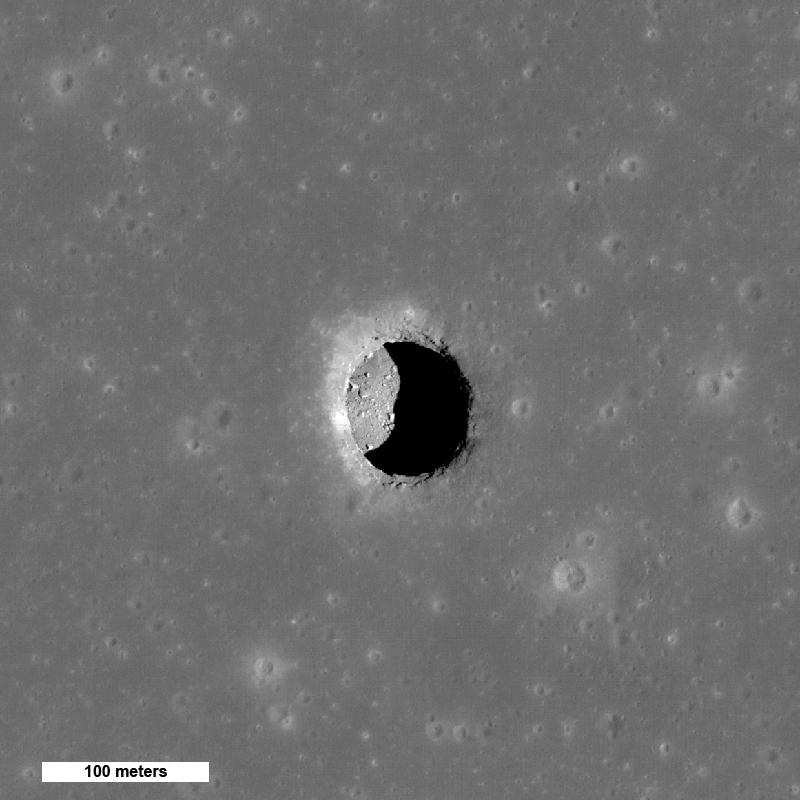
Scientists have long suspected that the Moon’s volcanic past left it riddled with tunnels, hollowed out by rivers of molten rock eons ago.1
Now, subtle variations in the Moon’s gravitational pull have yielded evidence of four such tunnels – each potentially more than a kilometer wide, concealed beneath just 100 meters of lunar rock.1
Such tunnels – particularly ones that haven’t collapsed – are a bit of a scientific Orthrus.1
On one hand, they represent an important window into the Moon’s geological history.1
On the other, they could one day become safe havens for lunar explorers, offering protection from the harsh radiation and temperature extremes to which the Moon is prone.1
A Lunar Landscape Marked by Sinuous Rilles
They can be found right here on Earth, forming when the surface of a flowing river of lava cools and hardens, creating an insulating roof beneath which molten rock continues to flow.1
On the Moon, these structures could be much more imposing, owing to different formation conditions.1
Weaker gravity, higher rates of lava eruption, and the relative ease with which lunar lava flowed could have allowed the formation of subterranean structures on a scale that dwarfs their terrestrial counterparts.1
Detecting the Gravity of a Tunnel
There’s also more than one way to skin a cat – or try to figure out what’s inside the Moon.1
Between 2011 and 2012, NASA’s twin Gravity Recovery and Interior Laboratory (GRAIL) spacecraft mapped the Moon’s gravitational field in unprecedented detail, measuring tiny changes in the distance between them as they flew over regions of differing gravity.1
It didn’t take too long for the kibosh to arrive, though – subsequent studies found that, in all likelihood, many of those tunnels would have been too wide to support the weight of their own roofs.1
So, when NASA released a higher-resolution model of the Moon’s gravitational field in May 2025, geoscientists Juan Losarcos and Andrew Dombard of the University of Illinois Chicago took another look to see if they could find something a bit more structurally sound.1
They painstakingly mapped tiny dips in the gravitational field, after accounting for the Moon’s surface topography, comparing them with simulations of the gravitational signatures that hollow tunnels of different dimensions would produce.1
Four candidates stood out: one in the vicinity of Vallis Schröteri, the largest sinuous rille on the Moon; one at Rima Mairan; and two near the Wollaston crater.1
In each case, the gravitational signature was consistent with a tunnel less than 2 kilometers.1
Sources
Every number in the story points here. Each links to the original reporting.
CenterScienceAlert Space
See a sentence its source doesn’t back up?
Tell us the source number and what’s wrong. We check every report. If we change the story, the fix goes on the corrections page with the old wording.