Democrats, forget the Voting Rights Act: Fix Rucho

Key facts
- An opinion piece in The Hill argues that the steady loss of Black political representation in some states traces back to Rucho v. Common Cause, the 2019 ruling that shut federal courts out of partisan gerrymandering disputes, more than to Louisiana v. Callais and its challenge to the Voting Rights Act.1
- In *Alexander v. South Carolina State Conference of the NAACP*, the Court sided with South Carolina, which said it moved thousands of Black voters out of a congressional district for partisan rather than racial reasons.1
- The fight over the Voting Rights Act alone cannot fix this gap, and Congress has the power to set national redistricting standards, and the Court itself acknowledged it.1
An opinion piece in The Hill argues that the steady loss of Black political representation in some states traces back to *Rucho v.1 Common Cause*, the 2019 ruling that shut federal courts out of partisan gerrymandering disputes, more than to *Louisiana v.1 Callais* and its challenge to the Voting Rights Act.1
Common Cause*, a 5-4 Supreme Court majority led by Chief Justice John Roberts held that partisan gerrymandering claims are “political questions” beyond the reach of federal courts.1
The case involved congressional maps in North Carolina and Maryland that were openly drawn for partisan advantage..1 Justice Elena Kagan warned in dissent that “Of all times to abandon the Court’s duty to declare the law, this was not the one.”1
How race and partisanship overlap
Race and party overlap heavily in much of the country, so a legislature that wants to break up Black voting power can call the move partisan strategy, and under *Rucho* no federal judge can stop it.1
The ruling stressed a presumption that legislatures act in good faith and set a high bar for proving race, rather than politics, drove the lines..1 The upshot is that when race and partisanship line up, states can redraw minority districts and point to *Ru0cho* to keep federal courts out.1
Louisiana v. Callais and Section 2
Callais* centers on Louisiana’s congressional map, which added a second majority-Black district after a federal court found the earlier map likely violated Section 2 of the Voting Rights Act.1
Opponents argued that drawing a district with race in mind is itself unconstitutional, putting the future of Section 2 in serious doubt.1
That case has drawn intense attention from Democrats and civil rights groups.1
The Hill piece argues that this focus overlooks how *Rucho* already gave states a legal workaround.1
What to do next
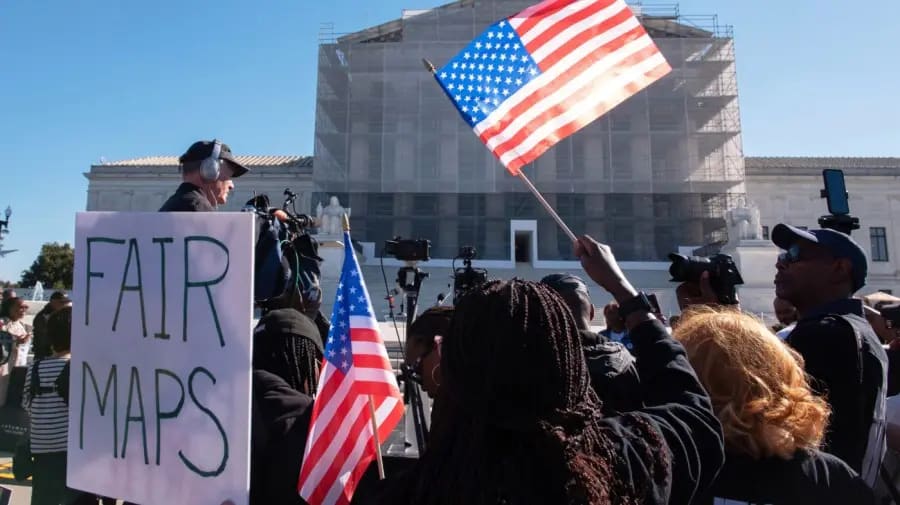
Restoring fair maps means taking on partisan gerrymandering directly, through Congress, state constitutions, and independent commissions.1
Congress has the power to set national redistricting standards, and the Court itself acknowledged it.1
State courts, state constitutions, and independent commissions remain open paths to reform.1
Defending Section 2 still matters, but it cannot protect voters whose districts are carved up under a partisan label.1
Takeaways *Rucho* made extreme partisan gerrymandering unreviewable in federal court..1 Because race and party are closely linked, a “partisan” defense can shield maps that dilute Black voting power.1
The fight over the Voting Rights Act alone cannot fix this gap..1 Tell them that protecting the Voting Rights Act is necessary but not enough, and that Congress has the constitutional authority to set fair map rules for every state.1
Sources
Every number in the story points here. Each links to the original reporting.
CompanyCrowdBlue
See a sentence its source doesn’t back up?
Tell us the source number and what’s wrong. We check every report. If we change the story, the fix goes on the corrections page with the old wording.