ESA’s Hera Mission Reveals Stadium-Sized Crater on Dimorphos

Key facts
In 2022, NASA crashed a spacecraft into an asteroid at nearly 15,000 miles per hour (24,000 kilometers per hour) as a first-of-its-kind test of a planetary defense system designed to alter the trajectory of an incoming object.1
Four years later, it looks like the asteroid is still dealing with the aftermath.1
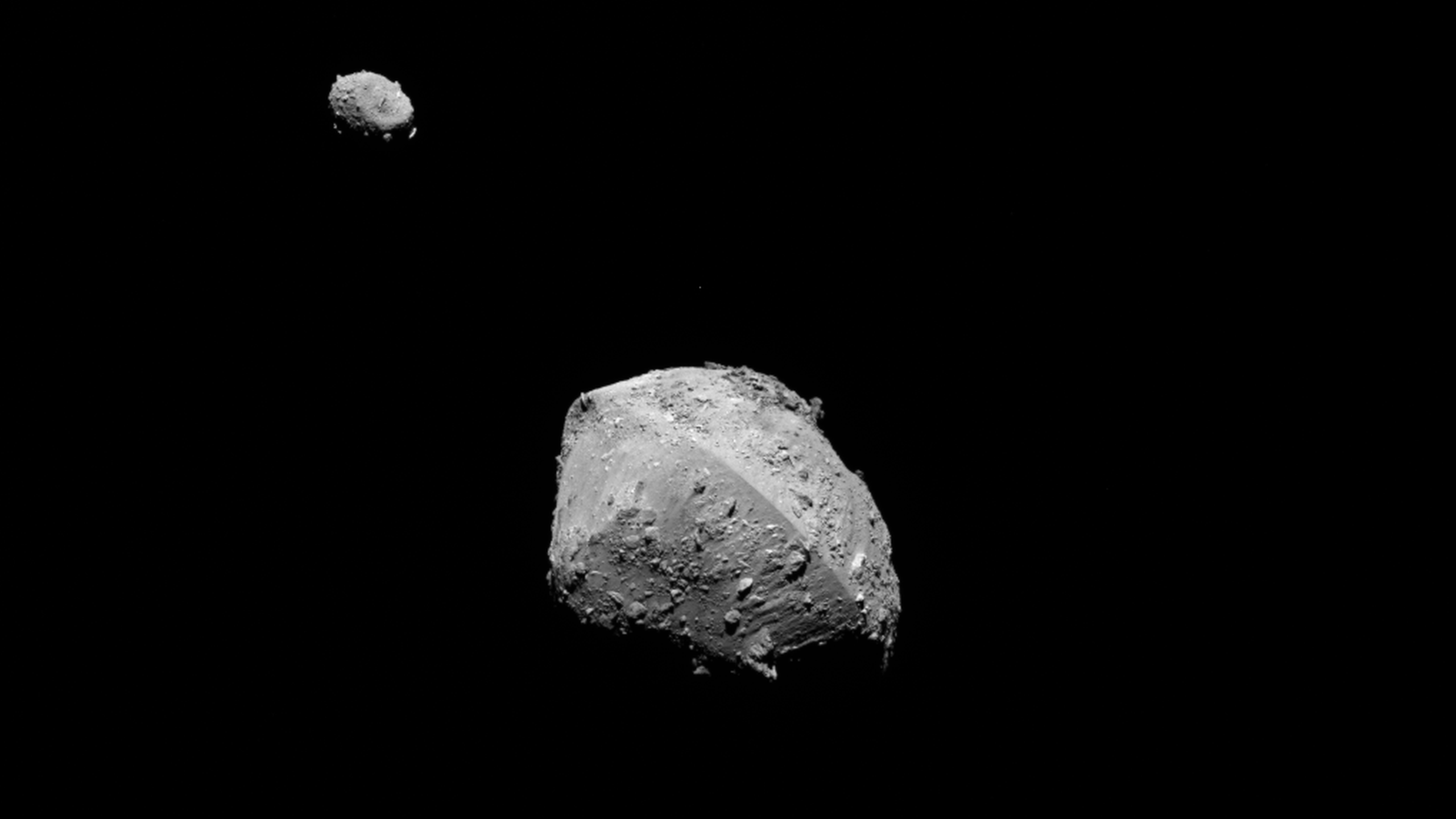
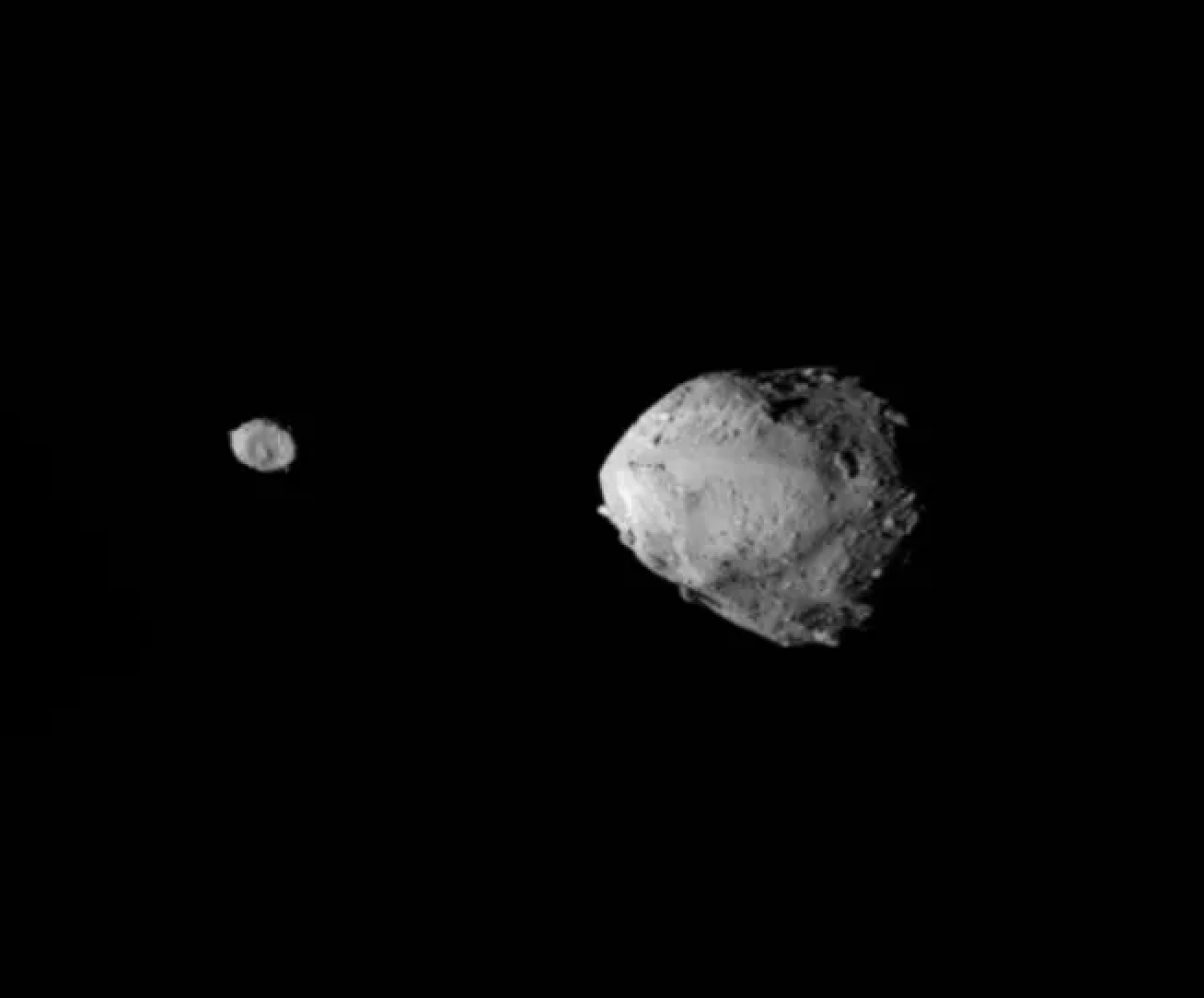
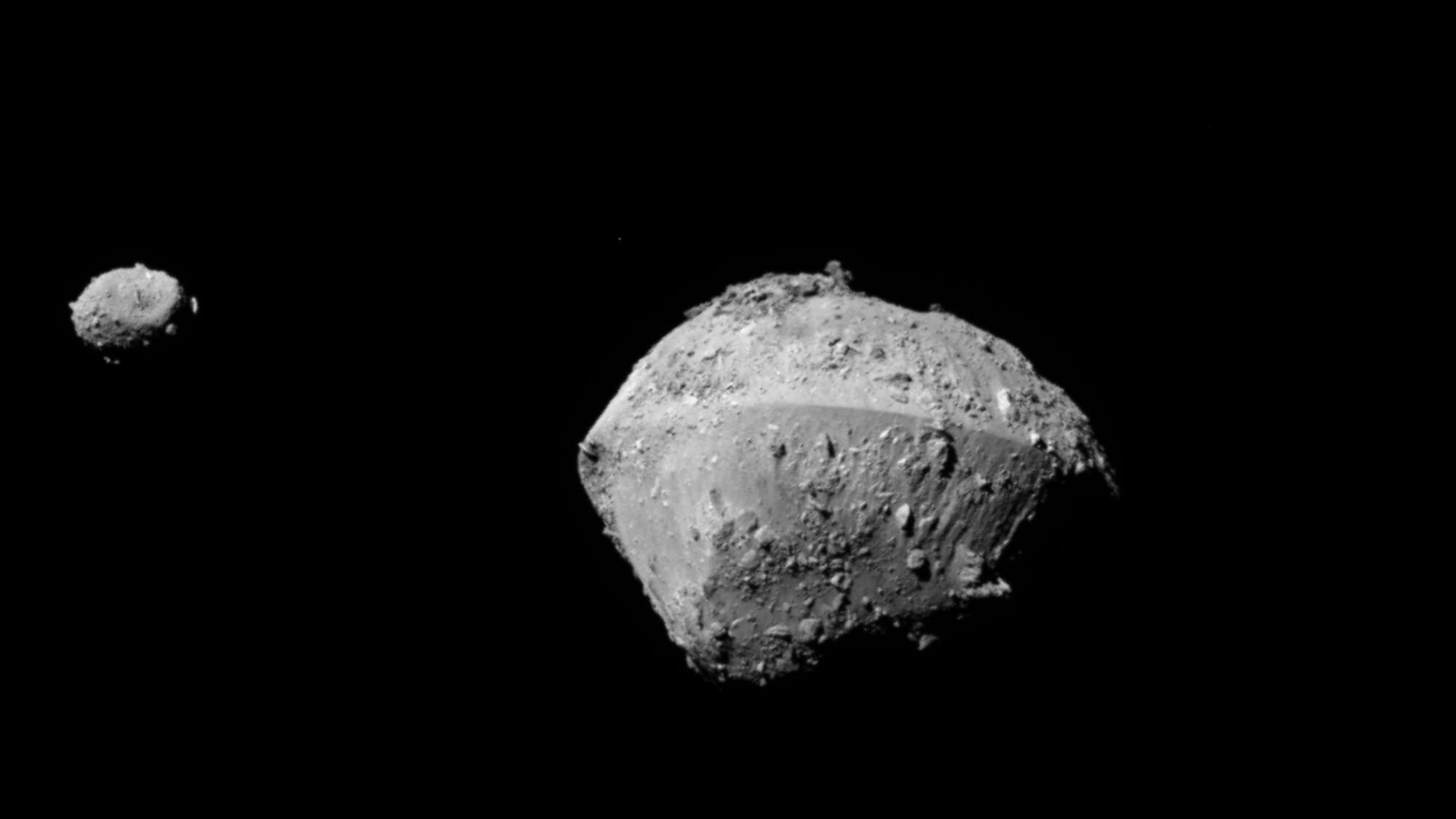
The European Space Agency (ESA) revealed the first images from its Hera mission, which was sent to observe the site of the crash.1
A stadium-sized crater and a chaotic tumble
The new close-up views of the asteroid show that DART left behind a stadium-sized crater and sent the space rock into a chaotic tumble.1
The side of Dimorphos that was struck by DART has been flattened into an impact crater the size of a sports stadium, which is almost as wide as the asteroid itself.1
The impact appears to have blasted loose previously unknown boulders, which are now encircling the targeted asteroid and its companion.1
“Scientists debated whether Dimorphos had sustained an impact crater, changed its shape or stayed the same,” Patrick Michel said.1 “Much to our surprise the answer turns out to be all three at once!”
What the images mean
Scientists debated whether Dimorphos had sustained an impact crater, changed its shape or stayed the same.1
The images showed that the asteroid system is surrounded by hundreds of orbiting boulders.1
“The team will have to take account of these objects in the coming weeks as the mission moves in closer to acquire higher-resolution images of the asteroids,” Michael Kueppers said.1
What Hera will do next
Hera, which launched on October 7, 2024, arrived at the asteroid three weeks ago and is currently about 19 miles (30 kilometers) away from the space rock.1
Its target is Dimorphos, a 558-foot-wide (170-meter) space rock that orbits its larger 2,625-foot-wide (800-meter) companion, Didymos.1
On September 26, 2022, NASA’s DART slammed into the asteroid, altering the rock’s orbit around its larger companion by shortening its orbital period by 33 minutes.1
Scientists were able to measure the orbital change using ground-based observations, but they needed a closer look to investigate what exactly happened to the tiny space rock.1
The car-sized spacecraft is designed to perform a detailed, post-impact survey with the aim of turning a one-time space experiment into a well-understood planetary defense mechanism.1
The mission could also help scientists learn more about how asteroids form.1
“NASA’s DART mission demonstrated that we can change an asteroid’s orbit. Hera is now revealing what happened to the asteroid itself,” Ian Carnelli said.1 “By combining these two missions, humanity is taking a decisive step towards making asteroid deflection a reliable tool for protecting our planet.”
Hera will continue to move in closer to the asteroid system before it deploys a pair of shoebox-sized miniature satellites, named Milani and Juventas, in early 2027.1
Milani is tasked with identifying the composition of materials on and around Dimorphos while Juventas will use a radar to peer inside the asteroid.1
Sources
Every number in the story points here. Each links to the original reporting.
LocalGizmodo
See a sentence its source doesn’t back up?
Tell us the source number and what’s wrong. We check every report. If we change the story, the fix goes on the corrections page with the old wording.