Key facts
NASA’s DART spacecraft moved an asteroid called Dimorphos four years ago in humanity’s first planetary defense test, a mission to explore whether it’s possible to stop an asteroid from hitting Earth.1
The European Space Agency’s Hera spacecraft has arrived at the asteroid to assess the damage and investigate what exactly happened when DART, or the Double Asteroid Redirection Test, slammed into the space rock at 13,645 miles per hour.1
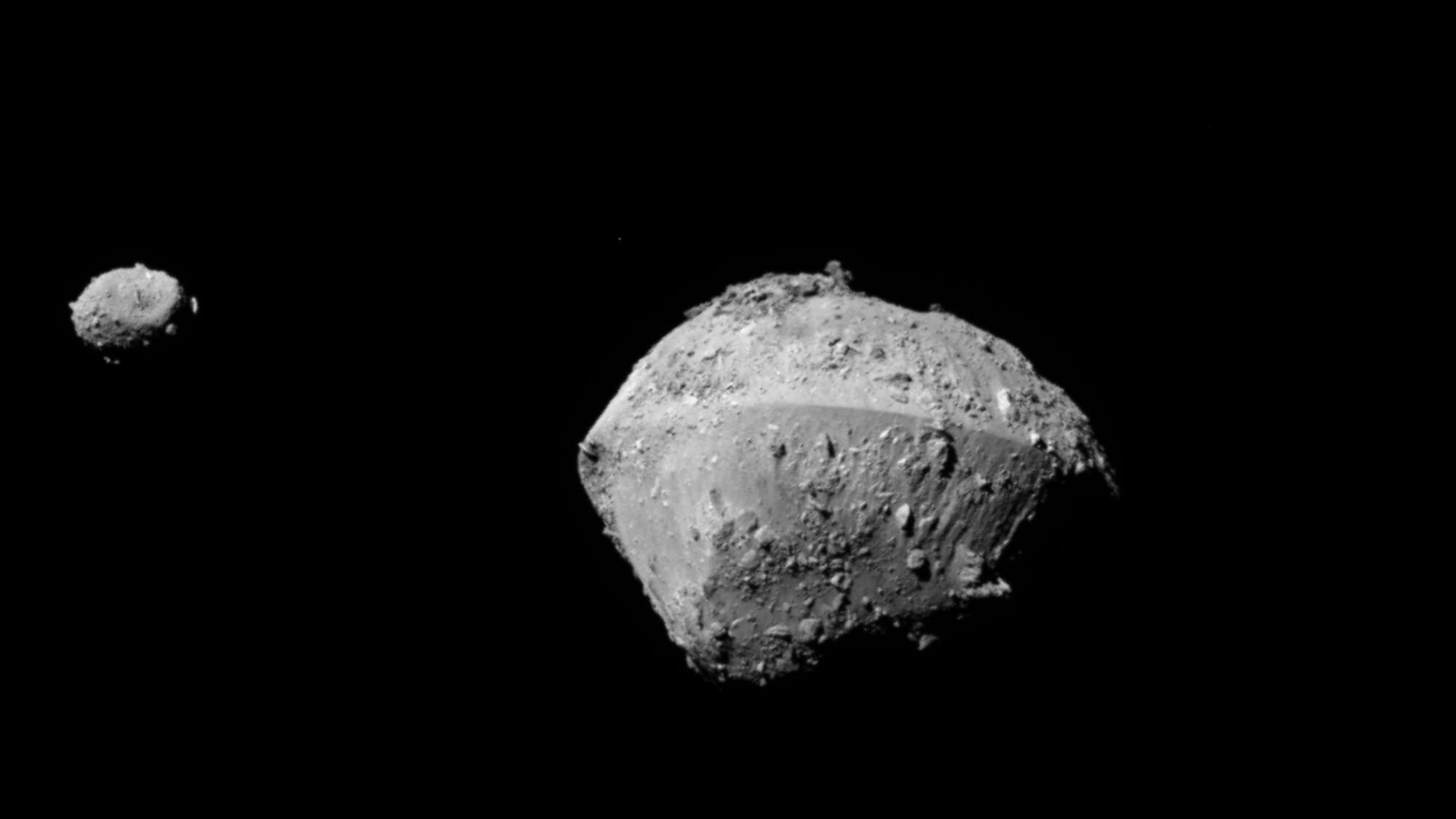
The ESA released the mission’s first images on Wednesday and shared some intriguing early observations, including a stadium-size crater that flattened one of the previously rounded faces of the asteroid and the surprise discovery of boulders encircling the asteroid.1
Sabina Raducan
Sabina Raducan, a planetary scientist at the International Space Science Institute in Bern, Switzerland, and the Free University of Brussels in Belgium, said at a news briefing in Berlin, “It’s a big crater that is almost as large as the body itself, which is really spectacular.”1
Hera, which launched in October 2024, arrived at Dimorphos three weeks ago and is currently about 30 kilometers (19 miles) from the space rock, which orbits a larger asteroid named Didymos in what’s known as a binary asteroid system.1
The impact from the 2022 DART mission also sent Dimorphos, which is 151 meters (495 feet) wide, into a chaotic tumble, according to initial observations.1
Raducan explained, adding that Neither Dimorphos is now moving like a “barrel that you throw down the stairs,” “Before the DART impact, Dimorphos was more like our own moon: It was always showing the same face.”1
Hundreds of boulders encircle the asteroid pair
The biggest surprise from Hera’s early observations is that hundreds of previously unknown boulders encircle the asteroid pair, including more than 100 that are between the size of a football and a washing machine, said Naomi Murdoch, a planetary scientist at the University of Toulouse, who is part of the mission team.1
Murdoch, adding that scientists needed more time to determine where the boulders came from and why, said, “We cannot say today, with the information that we have, whether these were debris coming from the DART impact or whether there’s another origin, for example, coming off the primary asteroid.”1
When asked whether DART would have observed the boulders in 2022 if they were already there, Raducan said the mission may have been moving too fast to make such an observation.1
The rest of Dimorphos does not exhibit evidence of major changes: The boulder fields covering its other regions look just like they did in DART’s 2022 images, the ESA noted.1
Astronomers used telescopes on Earth to assess the impact and aftermath of NASA’s DART mission, finding that the time it takes Dimorphos to orbit around Didymos was shortened by a much greater than predicted 33 minutes.1
The news briefing took place in the dinosaur hall of the Museum of Natural History Berlin, which the ESA said was a fitting reminder of why the mission mattered.1
Most dinosaurs went extinct after a city-size space rock hit the planet 66 million years ago.1