Read the original on CelebYachts →


This report is from CelebYachts, which tracks the superyachts of public figures.1
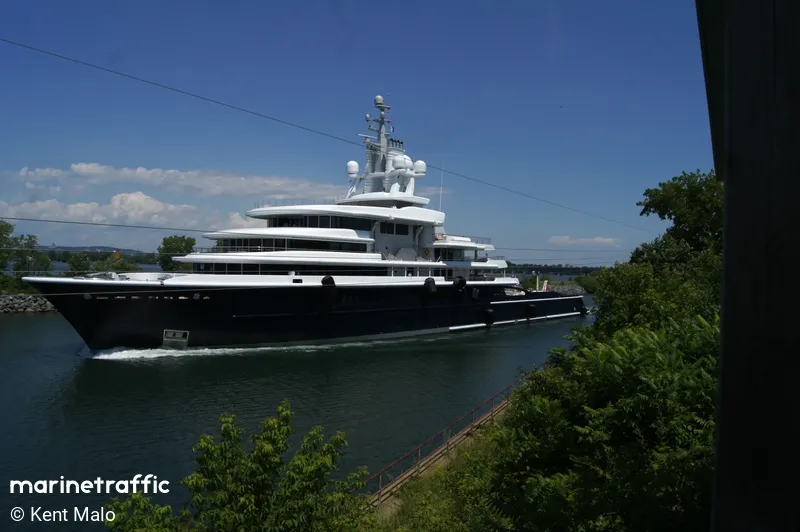
Luna’s ownership history demonstrates how marine assets migrate through trusts during matrimonial litigation and become immobilised by cross-border enforcement actions. The vessel’s timeline maps directly onto Farkhad Akhmedov’s legal battles and the geopolitical shifts of 2022.1
The hull known as Luna entered service when she was delivered to Roman Abramovich on 10 April 2010. Classified as the world’s second-largest expedition yacht, she measured 114.0 metres in length with a beam of 20.0 metres and gross tonnage of 5,655. Her exterior design came from NewCruise and her interior from Donald Starkey. Industry estimates placed her original construction cost at more than €250 million. Lloyd Werft in Bremerhaven executed the build. The yard, founded in 1863, operated primarily as a repair workshop for merchant fleets before specialising in superyacht maintenance. It occupied 260,000 square metres and could accommodate vessels drawing up to 11.5 metres. In 2016, following a majority stake purchase by Genting Hong Kong, the facility expanded by combining with Nordic Yards’ Wismar, Warnemunde, and Stralsund operations. It remained the last major dockyard in Bremerhaven until filing for bankruptcy in January 2022 and selling to new owners in March 2022.1
The delivery and the transfer
Four years after Luna’s delivery, in April 2014, the vessel changed hands again. She was sold to the Azerbaijani-Russian businessman Farkhad Akhmedov for €200 million. The transaction represented a discount on the initial build estimate, a common feature in secondary superyacht markets where immediate liquidity outweighs original capital outlay. Shortly after the sale closed, the new owner dispatched the yacht back to Bremerhaven. In October 2014, Luna entered Lloyd Werft for an extensive refit. The yard charged €50 million for the work, which lasted sixteen months before the vessel was delivered back to Akhmedov in March 2016. The Marshall Islands flag provides a commercial registry framework that allows for private ownership structures, but it does not shield against enforcement actions in ports where the owner holds assets or faces sanctions.1
The matrimonial ledger
Akhmedov’s acquisition of the yacht intersected with a complex financial and political history. Born in 1955, he moved to Moscow at age fifteen and served in the Soviet Navy before graduating from the Moscow Veterinary Academy in 1983. Between 1986 and 1994, he lived in London, initially trading furs internationally before founding Tansley Trading, a company that supplied equipment for the USSR’s oil and gas industry. He later entered politics, serving as a representative in the Federation Council of the Russian Federation until departing his role in 2009. His wealth accumulated through these industrial supply chains, placing him among Russia’s top two hundred richest individuals by 2011 with an estimated fortune of $1.4 billion. He maintains ties to his homeland as the main sponsor of the Azerbaijan Goychay Pomegranate Festival.1
The purchase of Luna coincided with a period of significant personal financial volatility. In 2012, his eldest son Teymur, then a student at the London School of Economics, lost more than $50 million in a single day of stock market trading. Two years later, in 2015, Akhmedov acquired the painting Untitled Yellow and Blue by Mark Rothko for $46.5 million. These expenditures occurred alongside a protracted legal battle with his ex-wife, Tatyana Akhmedova. The couple had been married three times and produced six children, who are believed to hold dual citizenship. The English High Court awarded Tatyana a disputed £453 million matrimonial settlement. Following the ruling, Farkhad and Tatiana settled their dispute privately.1
The trust structure meant that while Akhmedov retained beneficial interest, the legal title rested with the trustees, insulating the vessel from direct personal liability during the settlement process. The Blue Sea Trust operates as a standard offshore vehicle, separating legal ownership from economic benefit. This separation is critical when facing multi-jurisdictional claims, as it prevents creditors from seizing the hull directly. The trust’s existence means the yacht cannot be liquidated to satisfy the £453 million judgement without trustee consent.1
The maritime blockade
The geopolitical landscape shifted dramatically in 2022, altering the yacht’s operational status. Following the Russian invasion of Ukraine, multiple jurisdictions imposed sanctions on Akhmedov. The European Union, the United Kingdom, Canada, and Switzerland all added him to their restricted lists. In March 2022, Forbes reported that Luna remained registered in the Marshall Islands under Akhmedov’s ownership, with a declared value of $196 million. This figure diverged significantly from the register’s estimated value of $360 million, reflecting the market impact of the sanctions and the difficulty of pricing a frozen asset. Assets held by sanctioned individuals often trade at steep discounts because potential buyers face compliance risks. The sanctions effectively locked the vessel into its home port or designated safe harbours, preventing standard cruising itineraries.1
On 12 May 2022, German authorities moved to freeze the asset. By 23 May 2022, AIS records confirmed Luna was recorded in Hamburg, Germany. The freeze prevented any departure until the legal mechanisms enforcing the sanctions were resolved. Enforcement actions continued beyond the initial freeze. In early May 2023, public prosecutors conducted a search of the ship. The operation cited allegations that the sixty-seven-year-old owner had been concealing substantial assets he was suspected of holding within Germany. The search targeted the physical documentation and onboard systems, seeking evidence of asset diversion. The German freeze utilised existing anti-money laundering provisions to detain the vessel pending investigation into the origin of the funds used for the €50 million refit.1
The dockyard timeline
Prior to the sanctions, Luna had maintained a regular schedule of maintenance and transit. In October 2021, having undergone a refurbishment while based in Dubai, she set sail once again. She navigated through the Suez Canal into the Mediterranean and arrived at Lloyd Werft to undergo scheduled maintenance. The vessel carries the IMO identifier 1010222 and MMSI 538071095. Current registry data places her in the Ligurean Sea, though the narrative of her seizure anchors her to German waters. The combination of the frozen flag state registration, the Western sanctions, and the domestic criminal investigation created a multi-layered blockade around the vessel. Luna remains moored in German waters, her movement dictated entirely by the progress of the prosecution and the status of the sanctions regime. The yacht serves as a fixed point in the registry, illustrating how quickly a mobile luxury asset can become immobilised by international regulatory frameworks.1
Read this on celebyachts.com, where the figures are checked against the live register.1