Read the original on CelebYachts →


This report is from CelebYachts, which tracks the superyachts of public figures.1
Roman Abramovich entered the Russian privatisation auctions with approximately $100 million and exited ten years later for $13 billion. That liquidity funded the 162.5-metre Blohm+Voss hull delivered in 2010 and the 139-metre Lloyd Werft vessel launched in 2021. The fortune was not built through industrial management but through the execution of rigged auctions and state asset sales.1
The wealth behind Eclipse accumulated through the Russian privatisation auctions of 1995. Roman Arkadyevich Abramovich entered the loans-for-shares scheme with approximately $100 million, acquired a controlling stake in Sibneft, and sold it to the Russian government ten years later for $13 billion. That $13 billion exit created the liquidity that funded the 162.5-metre Blohm+Voss hull delivered in 2010, and it continues to underwrite the 139-metre Lloyd Werft vessel launched in 2021.
The loans-for-shares auction
Roman Arkadyevich Abramovich was born in Saratov in 1966 and raised in Ukhta after his parents died. He left school at sixteen and served in the Soviet Army before trading plastic ducks and diesel fuel in Moscow. These early ventures established a pattern of leveraging informal networks, but they generated negligible capital compared to what followed. The loans-for-shares programme was designed by Boris Yeltsin’s administration to secure funding for the 1996 presidential election. In exchange for financial and media support, businessmen were offered stakes in Soviet-era enterprises for tiny fractions of their worth. Abramovich met Boris Berezovsky on a yacht in the Caribbean to arrange the deal. Berezovsky used his influence to add Sibneft to the sale list two days before the auction deadline, paid off competing bidders, and secured the winning bid for Abramovich via the offshore vehicle Runicom Ltd. The purchase price was well below market value. As head of Sibneft, Abramovich reduced tax liabilities by hiring disabled workers and establishing shell companies in Kalmykia and the Chukotka Autonomous Okrug. The company avoided an underpayment investigation in 2001. In 2005, he sold his stake to the Russian government, led by Vladimir Putin, for $13 billion.1
The aluminum consolidation
In 2000, Abramovich applied the same consolidation logic to the aluminium industry. The sector had been ravaged by violence and strike action. David and Simon Reuben sold their aluminium assets to him for $575 million. He convened a meeting at the Balchug Kempinski in Moscow with Oleg Deripaska, Iskander Makhmudov, and Lev Chernoi. The four agreed to merge their operations into Rusal, which controlled 90 percent of the Russian aluminium market alongside SUAL Group. Two years later, in 2004, Abramovich sold his 50 percent stake in Rusal to Deripaska for £1.8 billion. The transaction made him the richest person in the world under the age of forty. He set up Millhouse Capital in 2001 to hold these investments, sharing ownership with Eugene Shvidler. Through Millhouse, he acquired stakes in Evraz, Highland Gold, Aeroflot, and RusPromAvto, selling them at various points over the following two decades. He also invested $120 million in Israeli high-tech start-ups and purchased office complexes in Moscow, including Four Winds Plaza for $370 million in 2013 and White Gardens for $750 million later that year.1
In 2011, Berezovsky filed a civil suit in the High Court of Justice in London, seeking over £3 billion in damages for blackmail and breach of trust. The case centred on a December 2000 conversation at Le Bourget airport, secretly recorded by Badri Patarkatsishvili, where Berezovsky demanded the legalisation of his aluminium interests. Abramovich’s lawyers argued this referred to anti-money laundering structuring. The judge, Elizabeth Gloster, dismissed the claim in August 2012, finding Berezovsky unreliable and Abramovich truthful. It later emerged that Gloster’s stepson had received almost £500,000 to represent Abramovich early in the case. Berezovsky stated the judgment felt written by Putin. Gloster declined to comment.1
The fleet and the holding structure
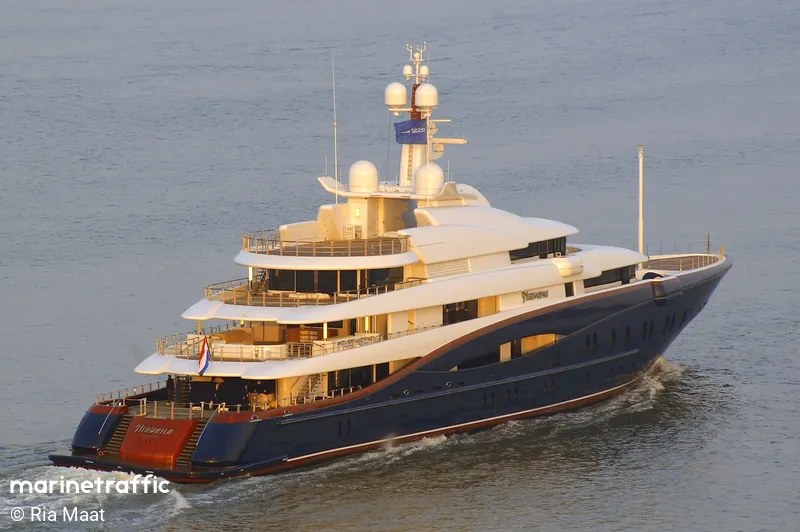
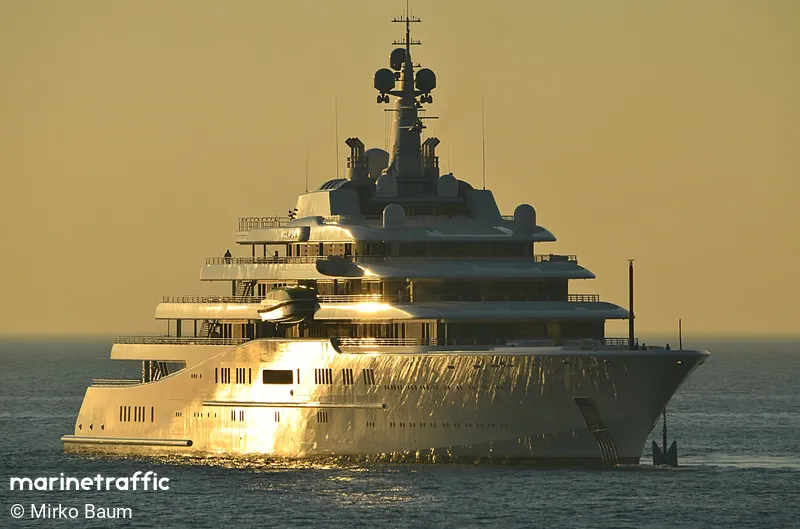
Eclipse arrived in the register as the direct beneficiary of the $13 billion Sibneft exit. Built by Blohm+Voss in Hamburg, she measured 162.5 metres and carried an estimated cost of €340 million. Her exterior and interior were designed by Terence Disdale. She required twenty-four guest cabins, two swimming pools, a disco hall, and approximately seventy crew members to operate. Security features included a missile detection system, self-defence systems, and a mini-submarine capable of reaching fifty metres. By 2009, she employed a rotor-based stabilisation system using the Magnus effect to counter roll motion at anchor. She held the record for the world’s longest private yacht until Azzam was launched in April 2013. After the 2022 Russian invasion of Ukraine, Eclipse anchored in Turkish territorial waters off Muğla Province, moving between Bodrum and Marmaris. She remains registered in the Cook Islands.1
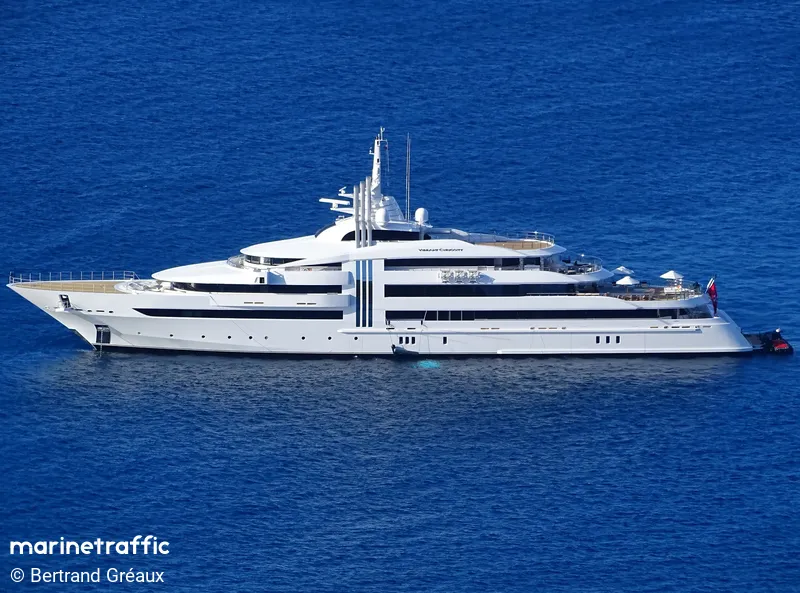
Solaris followed eleven years later. Built by Lloyd Werft in 2021, she measured 139 metres and carried an estimated value of $600 million. Like Eclipse, she flies the Cook Islands flag. When international sanctions began targeting Russian assets in March 2022, Solaris was in Barcelona for repairs. She put to sea on 8 March, moved to Tivat in Montenegro, and then proceeded to Turkish waters, docking at Bodrum between 21 March and 3 April before moving to another Turkish port around 5 May. Both vessels have evaded seizure by operating in jurisdictions that declined to enforce the restrictions.1
The third hull, GARÇON, measures 67 metres and was built by Damen in 2012. She is the first of class for the Sea Axe YS 6711 design. She also flies the Cook Islands flag. The registration of all three vessels in the Cook Islands aligns with the broader holding structure for Abramovich’s wealth. His assets are maintained in a web of companies, with a significant portion based in Jersey. Forbes values his net worth at $9.3 billion as of 2019, while Bloomberg L.P. reported $8.56 billion. The discrepancy reflects the opacity of the holding entities. Since the imposition of sanctions following the 2022 invasion, Abramovich has reportedly spent most of his time in Turkey. He holds Russian, Portuguese, and Israeli citizenship.1
Abramovich acquired Chelsea Football Club in June 2003 for approximately $190 million from Ken Bates. He spent more than £2 billion on player signings and hired thirteen managers. The club won twenty-one major trophies under his tenure, including two UEFA Champions League titles and five Premier League championships. In 2017, Chelsea received approval for a £500 million stadium replacement. Construction halted in May 2018 due to visa delays and an unfavourable investment climate. Catherine Belton accused him in her 2020 book Putin’s People of purchasing the team on Vladimir Putin’s orders; Abramovich sued for defamation and the defendants conceded the claims lacked factual basis. In 2022, it was reported that Abramovich was owed a $2 billion loan from Chelsea, arranged ahead of potential sanctions. He handed the club to the Chelsea Charitable Foundation in March 2022 and sold it to BlueCo in May.1
Read this on celebyachts.com, where the figures are checked against the live register.1