The thousand-mile gap between Jeddah and the Ligurian Sea

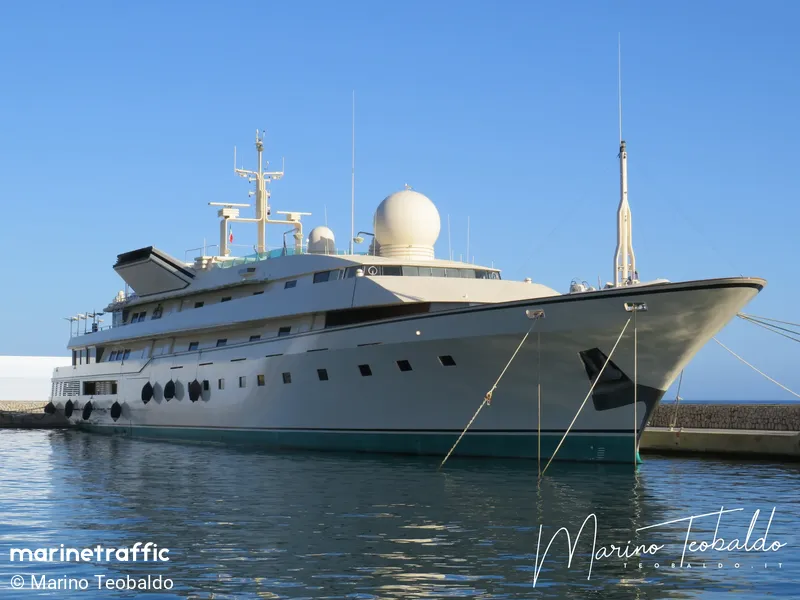
This report is from CelebYachts, which tracks the superyachts of public figures.1
The 86-metre superyacht owned by Prince Alwaleed bin Talal is registered in Jeddah, yet AIS data shows her spending her operational life off the French and Italian Riviera. Measuring the distance between the register and the track reveals how flag states function as administrative containers.1
The home port painted beneath the name of a superyacht functions as a legal address. It does not indicate a geographic coordinate. For Kingdom 5KR, that address is Jeddah, a city on the Red Sea coast of Saudi Arabia. The vessel’s actual position is recorded at 43.82° N, 7.79° E in the Ligurian Sea, hundreds of nautical miles away in the western Mediterranean. The distance between the register and the track separates administrative convenience from operational reality. A port of registry establishes the flag state, the applicable tax regime, and the jurisdiction for construction standards. It does not require the vessel to remain within the harbour limits of the named city, nor does it restrict the owner from operating the asset in international waters or foreign territorial seas.1
The legal address
Kingdom 5KR flies the flag of Saudi Arabia. The registration ties the hull to a specific national authority, which determines the Safety of Life at Sea conventions applied during construction and the labour laws governing the crew. Prince Alwaleed bin Talal was born in Jeddah in 1955, establishing a personal link to the port that appears under his name on the stern. The choice of Jeddah as the home port reflects the owner’s citizenship and the location of his primary corporate base, rather than the vessel’s cruising itinerary.1
The register functions as a static container for a mobile asset. Once the flag state is selected, the legal requirements for maintaining the registration are typically limited to annual fees, compliance audits, and crew documentation. There is no minimum number of days the vessel must spend in the home port’s waters to maintain the designation. This decoupling allows owners to select a jurisdiction based on fiscal efficiency or political stability, while the yacht itself follows weather patterns, market seasons, and personal preference. The AIS broadcast confirms the vessel’s location in real time, independent of the paper trail filed with the port authority.1
The Mediterranean circuit
The position archive for Kingdom 5KR shows a consistent pattern of movement along the coasts of France and Italy. In August 2026, the vessel executed a series of short passages through the Gulf of Lion and the Ligurian Sea. On 29 July, she moved 6 nautical miles from Monaco to Nice. Three days later, she covered 22 nautical miles from Nice to Cannes. By 3 August, she had completed a 37 nautical mile loop starting and ending in Cannes. On 4 August, she sailed 42 nautical miles from Cannes to Sanremo.1
These movements occur at speeds typical of coastal navigation. The maximum recorded speed during these passages was 15.6 knots, with average speeds ranging between 8.0 and 14.0 knots. The vessel never leaves the immediate vicinity of the French and Italian Riviera during this period. The distance from Jeddah to Cannes exceeds 2,000 nautical miles. The vessel crosses multiple international boundaries, passing through the Strait of Gibraltar and navigating the internal waters of Spain, France, and Italy, before arriving at her summer anchorage. The register in Jeddah records none of this transit. The flag state receives notifications of port calls only when local authorities request them, and the home port office maintains no record of the daily positions logged by satellite transponders.1
The capital behind the steel
The decision to register Kingdom 5KR in Jeddah traces back to the source of the capital that purchased the hull. Prince Alwaleed bin Talal began his business career in 1979 after graduating from Menlo College. He returned to Saudi Arabia and formed Kingdom Establishment in 1980 with $30,000 in start-up funds provided by his father. When those funds were exhausted, he secured a $300,000 loan from the Saudi American Bank. His early success came from partnering with a South Korean construction company in 1982, using the resulting commissions to fund real estate deals and stock market investments.1
By 1986, Alwaleed had acquired the underperforming United Saudi Commercial Bank. Through a series of mergers with the Saudi Cairo Bank and the Saudi American Bank, he created a leading Middle Eastern financial institution. The hostile takeover of the bank in 1986, followed by subsequent mergers in 1997 and 1999, generated the liquidity required for international expansion. In January 1991, he agreed to invest $590 million, approximately half his accumulated wealth, in a five-year convertible security paying 11 percent interest in Citicorp.1
It was in that same year, 1991, that Alwaleed purchased Kingdom 5KR for $20 million. The vessel had previously been owned by Adnan Khashoggi, who commissioned it in 1980, and Donald Trump, who bought it for $29 million and renamed it Trump Princess. Alwaleed renamed the yacht Kingdom 5KR, deriving the title from his Kingdom Holding Company, his lucky number, and his children’s initials. The purchase was funded by the returns from his banking and real estate operations in the Kingdom. The capital originated in Saudi Arabia, which dictated the flag state, even as the asset operated in European waters.1
The shipyard constraint
The physical dimensions of Kingdom 5KR reflect the engineering standards of the late 1970s. Benetti built the hull in 1980 as Nabila, measuring 86.01 metres in length with a beam of 13.23 metres. The gross tonnage sits at 2,328. The original interior design was handled by Luigi Sturchio. The propulsion system consisted of two 3,000 horsepower NOHAB Polar engines, providing a top speed of 20 knots and a cruising speed of 17.5 knots. The fuel capacity was 515,000 litres.1
When delivered, the yacht featured five decks, a disco, a cinema with seating for twelve, eleven opulent suites, and a helipad on the upper deck. The funnels were sloped outward to avoid interference with helicopter operations. A pool with a water jet was positioned in front of the heliport. The vessel carried a crew of 48 and two Riva tenders. She appeared in the 1983 James Bond film Never Say Never Again as the Flying Saucer, the mobile headquarters of the villain Largo. The yard launched Nabila for Adnan Khashoggi in 1979, which at 83 metres and 2,465 tonnes was the largest yacht of its time. Lorenzo Benetti died in 1980, and the company fell into financial difficulties until 1984, when it was purchased by Paolo Vitelli, the owner of Azimut, who renamed it Benetti Shipyard.1
The specifications of the hull impose constraints on where she can operate. A draught of 4.72 metres requires deep-water access for docking. The beam of 13.23 metres limits the width of berths available in older harbours. These physical realities determine the practical range of the vessel more accurately than the port of registry. The legal address in Jeddah grants the right to fly a specific flag. The displacement is a physical measurement.1
Read this on celebyachts.com, where the figures are checked against the live register.1
Sources
Every number in the story points here. Each links to the original reporting.
Not ratedCelebYachts
See a sentence its source doesn’t back up?
Tell us the source number and what’s wrong. We check every report. If we change the story, the fix goes on the corrections page with the old wording.