Read the original on CelebYachts →
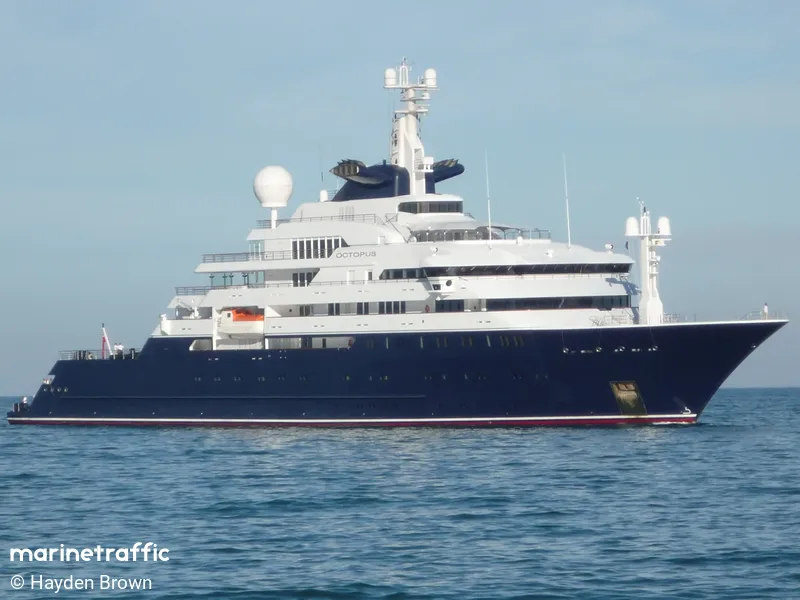
This report is from CelebYachts, which tracks the superyachts of public figures.1
Octopus holds Cayman Islands papers filed through George Town while her AIS broadcasts place her in the South Pacific. The gap between those two points is not a routing error. It is the standard distance between a legal address and a working vessel.1
Octopus’s home port is George Town. Her actual position is logged in the South Pacific. The difference between the two is measured in thousands of nautical miles and tells us nothing about her movements. A port of registry is a jurisdictional choice. It determines taxation, crew certification, and classification society oversight. It does not predict where a 126-metre research platform will anchor. The register records an address. The AIS records a location. They serve different purposes and rarely overlap.1
The GEORGE TOWN address
The register lists George Town under home port and Cayman Islands under flag. The address appears on the transom. It is a static datum. Our archive places her at 17.83° S, 177.18° E in East Australia. That coordinate sits well outside the Caribbean basin. The gap between the painted port and the live track exceeds ten thousand nautical miles. We state the discrepancy once. The rest of the record concerns what she does while she sits there. Cayman Islands registration offers a streamlined administrative framework for foreign-owned vessels. It requires annual fees and compliance audits but imposes no requirement for the owner to visit the islands. The paperwork travels by courier. The hull stays where the work takes it.1
The south Pacific track
The voyage log for August 2026 shows a cluster of movements around Fiji and Vanuatu. She departed Lautoka for a point 36 nautical miles off Nadi on 11 August, covering 77 nautical miles at an average speed of 10.6 knots. Five days earlier she had made a 54 nautical mile passage between two waypoints off Port Vila at 11.8 knots. The shorter hops tell a clearer story. On 10 August she ran 11 nautical miles between Nadi and herself in ninety minutes. On 8 August she covered 20 nautical miles at 6.9 knots. On 7 August she moved 13 nautical miles from Nadi to Lautoka. On 9 August she completed a 27 nautical mile run between the same ports. On 5 August she travelled 41 nautical miles from Sigatoka to Momi. The coverage percentages vary from thirty-three to one hundred, indicating intermittent satellite tracking rather than continuous broadcast. The speeds never exceed 13.1 knots. The pattern matches station-keeping and local transit. It does not match long-range cruising.1
The engineering of a research platform
The reason for the loitering lies in the steel. Octopus was designed as a floating laboratory. The exterior comes from Espen Øino Naval Architects and the build split between Lürssen in Bremen and Howaldtswerke-Deutsche Werft in Kiel. The interior was laid out by Jonathan Quinn Barnett across eight decks. The specification prioritises deployment over accommodation. She carries two helicopter pads on the main deck: a twin pad with hangars at the stern and a single pad on the bow. A 43-foot tender sits in the transom alongside a landing craft. There are seven tenders in total. Side hatches at the waterline form a dock for personal watercraft. A pool sits aft on an upper deck. The arrangement leaves the lower decks free for machinery and storage.1
The split construction reflects the yard’s domestic capacity limits. Lürssen handled the exterior lines and final assembly in Bremen, while Howaldtswerke-Deutsche Werft managed major structural sections in Kiel. This Division of labour allowed the project to proceed without waiting for a single slipway. Lürssen remains the largest yacht builder in the world, operating facilities in Lemwerder, Rendsburg, Wolgast, Hamburg, and multiple Bremen sites. The decision to use a second German yard for Octopus in 2003 anticipated the congestion that would later define the industry. The hull number and keel laying date are not recorded in the public sources, but the dual-yard approach left a permanent seam in the procurement schedule.1
The internal volume accommodates the research gear without compromising stability. The eight decks include a dedicated owners' level, separate from the guest and crew zones. The forward-facing observation area provides unobstructed sightlines for surface surveys. The centralised placement of the twin helicopter pad and stern hangars balances the heavy aviation fuel and maintenance equipment away from the bow. The single bow pad serves as a secondary lift point when the main deck is occupied. The side hatches at the waterline allow direct access to the sea for small craft without deploying the larger tenders. The pool sits aft on an upper deck, keeping the primary flight deck clear for aviation operations. The seven tenders and landing craft are stored below the waterline or in the stern cradles. The layout confirms that the vessel was built to host scientists and equipment, not to chase warm weather.1
The corporate transfer
The original owner understood the design intent. Paul Allen commissioned Octopus and launched her in 2003 at a reported cost of $200 million. He used the vessel for scientific research and rescue missions. In January 2011 a helicopter forced an emergency landing off Argentina. In 2012 he loaned the ship to the Royal Navy to retrieve the bell from HMS Hood, which sank in the Denmark Strait during the Second World War. The bell was located in 2015 and recovered by the onboard ROV after conservation. In March 2015 an Allen-led team announced the discovery of the Japanese battleship Musashi in the Sibuyan Sea. Allen died in 2018.1
The rescue operations required specific modifications to the standard luxury fit-out. The helicopter emergency landing off Argentina in January 2011 damaged the aircraft severely but caused no loss of life. The co-pilot suffered minor injuries. Allen was not aboard. The Royal Navy loan request in 2012 targeted the Denmark Strait, where HMS Hood sank to a depth of 9,000 feet after being hit by the German battleship Bismarck. The magazines exploded and the ship sank in minutes with over 1,400 lives lost. The bell was located in 2015 but could not be retrieved due to adverse weather. The announcement on 7 August 2015 confirmed the bell had been recovered by the ROV. After conservation, it went on display in 2016 at the National Museum of the Royal Navy in Portsmouth. The Musashi discovery in March 2015 took place in the Sibuyan Sea off the Philippines. The battleship displaced 73,000 tonnes at full load and carried 46 cm main guns.1
The financial trajectory of the hull tracks the broader market for pre-owned megayachts. The €295 million asking price in September 2019 reflected the premium attached to a proven research platform. The reduction to €235 million indicated a cooling market for large custom builds. The 2021 sale closed without public disclosure of the final sum. The identification of Roger Samuelsson came later through insideryachtfan.com. Samuelsson holds Swedish citizenship and leads a pharmaceutical enterprise. His net worth sits at $4.1 billion. He purchased the vessel as a private asset rather than a commercial charter. The estimated value remains at $295 million. The corporate chain is now complete. The vessel remains registered in George Town while the AIS data keeps her in the South Pacific.1
Read this on celebyachts.com, where the figures are checked against the live register.1