Read the original on CelebYachts →
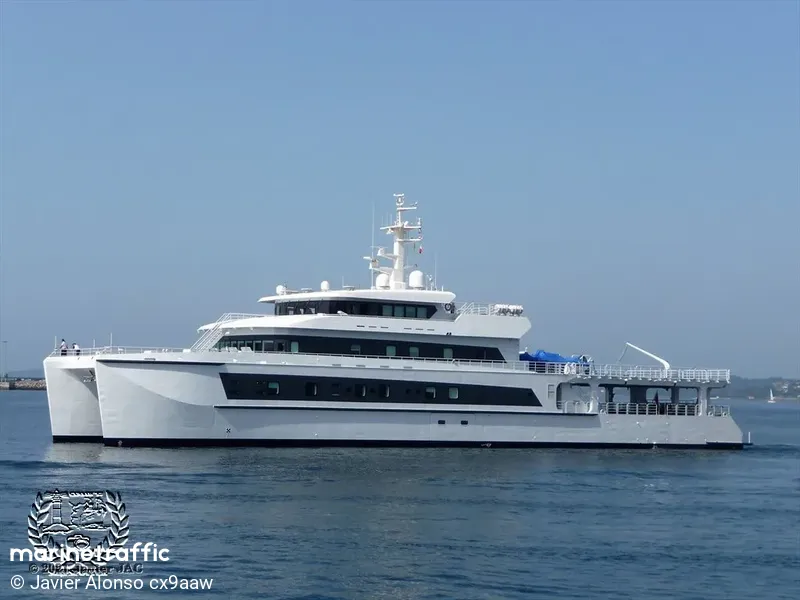
This report is from CelebYachts, which tracks the superyachts of public figures.1
A yacht’s home port is a legal address that rarely matches its operational ground. AIS broadcasts place Wayfinder in the Mediterranean, thousands of nautical miles from her registered base in George Town. The gap reveals how offshore registries function as administrative shells, while the vessel itself follows the seasonal schedules of European waters.1
Wayfinder carries a painted home port of George Town under her stern. The Cayman Islands registry assigns that address to vessels that have never crossed the Atlantic. Her actual operating ground is defined by AIS broadcasts: she has spent the summer of 2026 shuttling between ports on the French Riviera. The distance between George Town and the Ligurian Sea is measured in nautical miles, but the more significant gap is administrative. A yacht homed in George Town operates according to the schedules of the Mediterranean coast, not the trade winds of the Caribbean. The registry provides a legal shell; the transponder reveals the routine.1
The build and the engineering constraint
The vessel was constructed at Astilleros Armón in Burela, La Mariña Central, Galicia. It is the largest boat ever built at that yard. Designed by Incat Crowther, the Australian naval architecture firm, Wayfinder is a 68.2-metre aluminium catamaran. The multihull form dictates a 14-metre beam and a shallow draught of 2.40 metres. These dimensions allow her to carry 1,737 gross tonnes of auxiliary equipment without requiring deep-water berths. Her primary function is to supply a larger pleasure yacht with fossil fuel, foodstores, parts, and maintenance staff. An internal hangar stores a helicopter and a lifeboat, while the deck space accommodates fast launches, diving equipment, quads, motorcycles, and a minisubmarine. She carries 200,000 litres of diesel to power her twin 3,850-horsepower engines, which push the hull to a maximum speed of 21 knots. The vessel was launched on 10 December 2020 without a traditional ceremony to maintain confidentiality regarding the owner.1
Only the second megayacht supply ship built as a catamaran, Wayfinder features four decks and ample warehouse space that can be repurposed for multiple uses. She is crewed by 18 employees and includes built-in space for 14 passenger employees who form part of the primary yacht’s technical team. The vessel maintains an internal garbage dump to deposit solid waste in harbour, alongside dedicated laundry facilities, pantries, workshops, and spare parts warehouses. In late 2021, reports indicated the vessel may have carried a 30-member security detail. The combination of high fuel capacity, extensive storage, and rapid transit capability defines her role as a mobile logistics platform rather than a leisure craft.1
The track and the silence
AIS data places Wayfinder off the coast of France throughout July and August 2026. On 28 July she moved 30 nautical miles from Saint-Tropez to Antibes at an average speed of 11.5 knots, completing the passage in 2 hours and 38 minutes with full signal coverage. Three days later she covered 29.4 nautical miles from Nice to Saint-Tropez, averaging 12.7 knots and reaching a maximum of 13.5 knots. On 5 August she completed a 32-nautical-mile passage to Cagnes-sur-Mer, reaching a top speed of 16 knots and averaging 14.4 knots over a 2-hour and 27-minute run. Since that final broadcast, the vessel has held station at 43.29° N, 6.64° E in the Ligurian Sea. The archive shows no further movement. The gap between her declared home port and her observed position is static; she is anchored in European waters while her registration remains fixed in the Caribbean.1
The AIS coverage for all three passages recorded in August 2026 reached 100 per cent, confirming continuous tracking across the coastal waters of Provence-Alpes-Côte d’Azur. The voyages were short hops, ranging from 29.4 to 32.7 nautical miles, consistent with a Support vessel positioning itself near luxury marinas rather than undertaking open-ocean crossings. The maximum speeds recorded during these legs—16 knots, 13.5 knots, and 15.2 knots—remain well below the hull’s rated 21-knot ceiling, indicating operation within standard cruising parameters rather than high-speed transit. The shallow 2.40-metre draught allows the catamaran to access sheltered bays and smaller harbours that draw-limited superyachts cannot reach, reinforcing her role as a tender that operates independently of deep-water infrastructure.1
The ownership structure
The ownership structure surrounding Wayfinder remains opaque. Public records attribute the vessel to Bill Gates, though the subject has publicly denied owning the yacht. During construction, contract terms enforced shielded confidentiality, preventing the disclosure of the buyer’s identity. Reports indicate Gates placed the yacht up for sale in 2024, suggesting a shift in the holding structure or an attempt to distance himself from the asset. Gates accumulated his wealth following the initial public offering of Microsoft in 1986, which propelled him to become the world’s youngest billionaire in 1987 at age 31. His net worth stands at approximately $96,500,000,000. The corporate architecture surrounding his assets typically routes through Cascade Investment LLC, a private holding company based in Kirkland, Washington. The specific entity that purchased Wayfinder remains undisclosed, leaving the legal title separate from the individual who financed the hull.1
Interior design by the Basque firm Oliver Design shapes the four-deck layout, though the functional requirements of a supply vessel dictate the arrangement over aesthetic considerations. The internal hangar can store up to three 12-metre auxiliary boats, supplemented by two smaller craft on deck. This configuration transforms the vessel into a floating workshop and fuel depot, capable of sustaining a primary yacht for extended periods away from commercial ports. The 200,000-litre diesel capacity ensures the mothership does not need to divert for bunkering, while the onboard workshops and spare parts warehouses handle routine maintenance. The presence of a minisubmarine and diving equipment suggests the vessel also supports underwater exploration or inspection tasks for the principal yacht.1
Gates co-founded Microsoft in 1975 with Paul Allen, stepping down as chief executive officer in 2000 and serving as chief software architect until 2008. He resigned from the board in 2020. Over time, he reduced his corporate role to focus on philanthropic work with the Bill & Melinda Gates Foundation, which he co-chaired until 2024. He founded the Giving Pledge in 2010 alongside Warren Buffett, committing to donate half their wealth to charitable causes. The foundation’s focus spans health, education, and poverty alleviation, including efforts to combat transmissible diseases such as tuberculosis, malaria, and polio. Despite the scale of his charitable operations and the complexity of his investment portfolio, which includes stakes in AutoNation and Canadian National Railway, the precise corporate vehicle that acquired Wayfinder has not been published. The vessel sits at anchor in the Ligurian Sea, registered in George Town, owned by an entity that exists only in maritime ledgers.1
Read this on celebyachts.com, where the figures are checked against the live register.1