Read the original on CelebYachts →
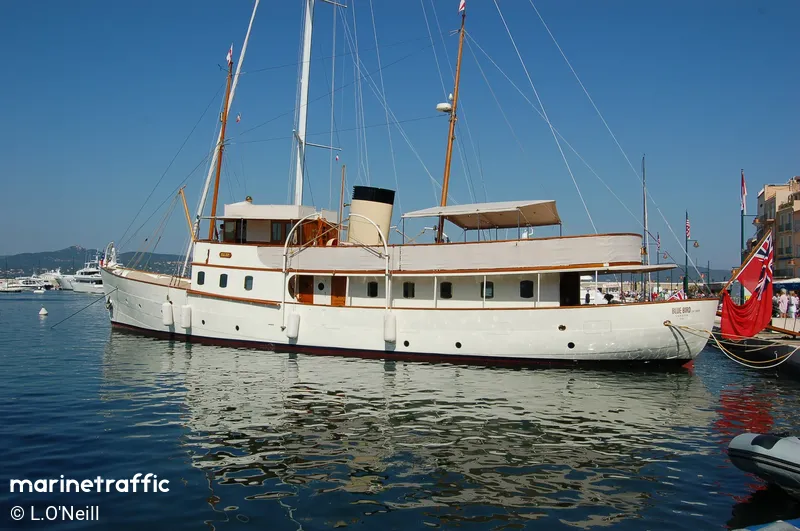
This report is from CelebYachts, which tracks the superyachts of public figures.1
Most large leisure craft are encrypted behind offshore foundations. This 1938 motor yacht carries a different kind of transparency. Her AIS tracks reveal a vessel constrained by interwar engineering, moving slowly around Saint-Tropez under a registry that has never been restructured.1
Why is Sir Malcolm Campbell still listed as owner?
The register lists her owner as Sir Malcolm Campbell. He died in 1948. The boat has kept his name on the paper for eighty years.1
Most yachts over fifty metres use complex layers of shell companies. Those layers hide the true beneficiary from public view. Blue Bird of 1938 shows no such layers. Her ownership is flat and direct.1
A living person or entity operates her today. But the legal title sits with a dead man. This piece explains how that works and why it matters.1
Who was Sir Malcolm Campbell?
Sir Malcolm Campbell was a British racing driver. He held world speed records on land and water. He used vehicles named Blue Bird. His son Donald later held both land and water records too. The family name is tied to speed.1
Campbell was born in 1885. He worked at Lloyd’s of London before racing. He won motorcycle trials between 1906 and 1908. He started racing cars at Brooklands in 1910.1
He married twice and divorced twice. His second wife Dorothy described him as unfit for family life. They divorced in 1940. He married again in 1945.
His career defined an era of motorsport. He wrote motoring mystery novels too. One became a film called Burn 'Em Up O’Connor. He narrated a driving test film for Ford in 1935.1
How was Blue Bird of 1938 built?
Goole Shipbuilding & Repairing Co. built her. The yard was unit 331 in our data. She launched in 1938. She is a motor yacht. Her length is 31.59 metres. Her beam is 6.03 metres.1
Her gross tonnage is 137. This measures her internal volume. It is small for a modern superyacht. It fits a vessel of this size and era. The design reflects the engineering limits of the thirties.1
Goole was a major British shipyard. It built merchant ships and warships. It was part of British Shipbuilders from 1977. That state corporation managed UK Shipbuilding until the eighties.1
British Shipbuilders closed many yards. It sold others to private buyers. Goole remained independent through the privatisation. It still exists today as a repair yard.1
The steel hull is old but sound. She has moved under her own power recently. AIS data shows her making voyages in 2026.1
Where does she sail now?
She sails near the French coast. Her home port is London. Her flag is the United Kingdom. This is unusual for a yacht of this value and age.1
AIS data tracks her movements closely. She spent August 2026 near Saint-Tropez. She made short trips along the French coast.1
One voyage ran from Palma to Mahón. It covered 101.6 nautical miles. Another went from Saint-Tropez to Palma. That trip was 260.1 nautical miles long.1
Her speeds are modest. Average speeds range from 4.4 to 10.7 knots. Max speeds hit 12.3 knots. These numbers match her 1938 design.1
She stays in warm waters. The Ligurean Sea is her latest area. She is last seen at 43.18° N, 6.64° E.1
How fast can Blue Bird of 1938 go?
Her maximum recorded speed is 12.3 knots. This occurred during a short hop from Antibes to Cannes. The distance was just 11.2 nautical miles. The trip took less than two hours.1
Another run reached 12.1 knots. That voyage linked Saint-Tropez to Palma de Mallorca. It covered 260.1 nautical miles in twenty hours. The average speed was 10.6 knots.1
Her lowest average speed was 4.4 knots. That was a five-mile loop in Saint-Tropez. She spent eighteen minutes there. The data coverage was only fifty percent.1
These figures reflect her original engine capacity. Interwar designs prioritised reliability over raw pace. Modern yachts of similar length often exceed 15 knots. Her performance is consistent with her age.1
Why is the registry so simple?
The registry shows only one name. Sir Malcolm Campbell is the owner. No holding company appears. No foundation is listed.1
Modern yachts use trusts to protect assets. Those trusts separate legal title from benefit. The beneficial owner stays hidden.1
Blue Bird of 1938 has no such separation. The legal owner is the historical figure. This creates a transparency gap.1
We know who bought her. We do not know who runs her now. A living operator manages the vessel. But that operator is not on the register.1
The opacity is structural. It comes from the gap between death and management. The owner is gone. The asset remains.1
What does this mean for ownership?
Ownership here is reported, not certified. We list Sir Malcolm Campbell because the register says so. We know he did not buy her in 2026.1
The real owner is unknown. They could be a descendant. They could be a collector. They could be a syndicate.1
The register gives no clue. The AIS gives no clue. Only the steel and the speed tell us she lives.1
Most yachts hide their owners well. Blue Bird of 1938 hides hers by accident. The lack of a corporate veil looks like openness.1
The registry is a snapshot of 1938. It has not been updated since. The law allows this. The practice is common for Historic vessels.1
Why is the registry so simple?
What does this mean for ownership?
What does this mean for ownership?
Read this on celebyachts.com, where the figures are checked against the live register.1