Pluto’s Icy Heart Was Formed by a Billion-Year Collision

Key facts
- Pluto has not been considered a planet in the Solar System since 2006.1 According to scientist Douglas Hamilton, the impact allowed moving ice to accumulate over time.1 On this side of Pluto, where the ice accumulates, there are never any rays of light reflected by Charon, its moon, since Pluto and Charon always face each other on the same side.1 The area is considered an ice cap, located at 30 degrees north on Pluto.1
- In July 2015, a spacecraft sent by NASA flew past the dwarf planet.1 The spacecraft was named New Horizons.1 New Horizons discovered the giant heart-shaped nitrogen glacier, as well as smooth icy plains, ridges and possible volcanoes.1
- Mercury also has a crater of a similar size, where the Caloris Basin is located.1 Despite losing this status, the dwarf planet continues to fascinate scientists, particularly because of its surface and its icy heart.1 There is every reason to believe that Pluto has not yet revealed all its secrets.1
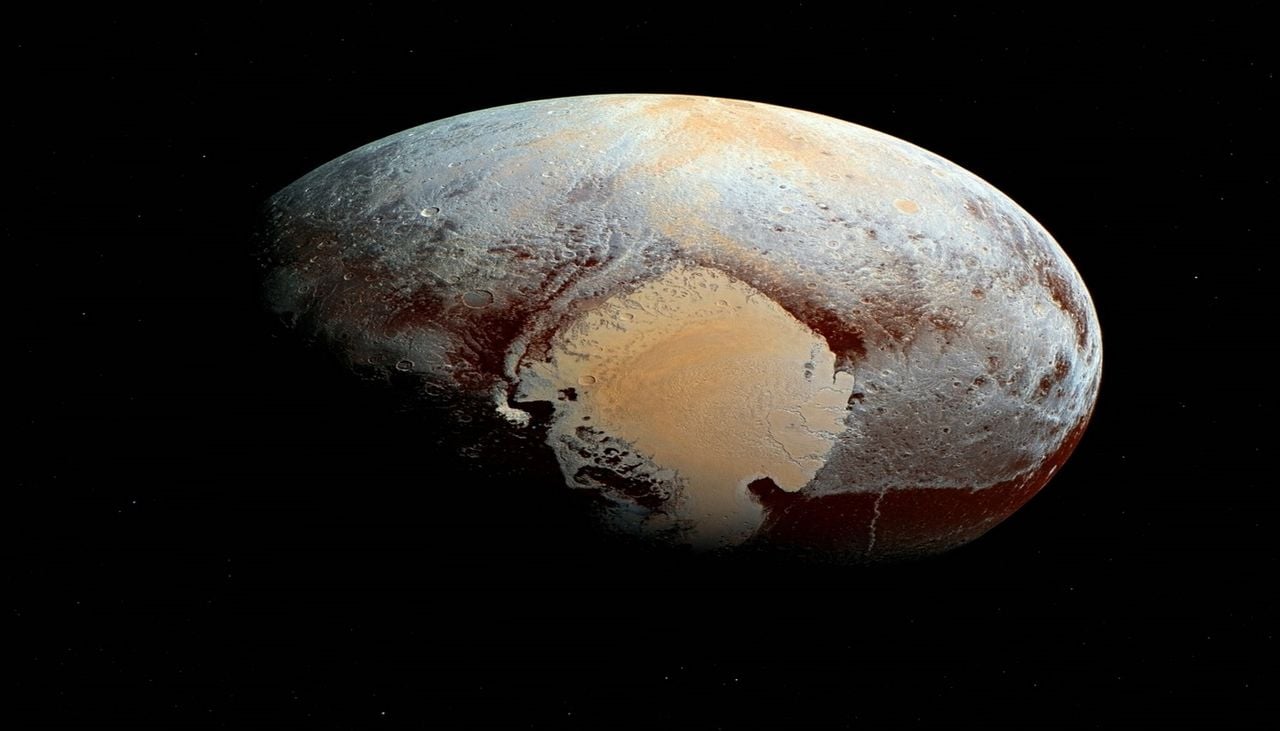
Pluto is distinguished by an unusual formation created by a massive collision that occurred several billion years ago..1 The formation is a giant nitrogen glacier shaped like a heart, now known as the icy heart, located on Pluto.1
After a piece of debris struck the dwarf planet, an 825-kilometre-wide crater formed on its surface, known as the icy heart due to its unmistakable heart shape..1 Scientists believe the shape can be explained by the impact itself.1
According to Dr Harry Ballantyne and several of his colleagues, the fragment did not strike Pluto head-on..1
“Pluto’s core is so cold that this object remained very hard and did not melt despite the heat of the impact,” Ballantyne said.1
How the Icy Heart Formed
Thanks to the angle of impact and the low speed, the core of this object did not sink into Pluto’s core, but remained intact, like a splash on top of it..1 The icy heart is located on Pluto in a region known as Tombaugh Regio.1
In July 2015, a spacecraft sent by NASA flew past the dwarf planet..1 The spacecraft was named New Horizons..1 New Horizons discovered the giant heart-shaped nitrogen glacier, as well as smooth icy plains, ridges and possible volcanoes.1
A Cold Core and a Fascinating Dwarf Planet
Pluto has not been considered a planet in the Solar System since 2006..1 According to scientist Douglas Hamilton, the impact allowed moving ice to accumulate over time..1 On this side of Pluto, where the ice accumulates, there are never any rays of light reflected by Charon, its moon, since Pluto and Charon always face each other on the same side..1 The area is considered an ice cap, located at 30 degrees north on Pluto.1
Mercury also has a crater of a similar size, where the Caloris Basin is located..1 Despite losing this status, the dwarf planet continues to fascinate scientists, particularly because of its surface and its icy heart..1 There is every reason to believe that Pluto has not yet revealed all its secrets.1
Sources
Every number in the story points here. Each links to the original reporting.
CenterMeteored United Kingdom
See a sentence its source doesn’t back up?
Tell us the source number and what’s wrong. We check every report. If we change the story, the fix goes on the corrections page with the old wording.