Read the original on CelebYachts →
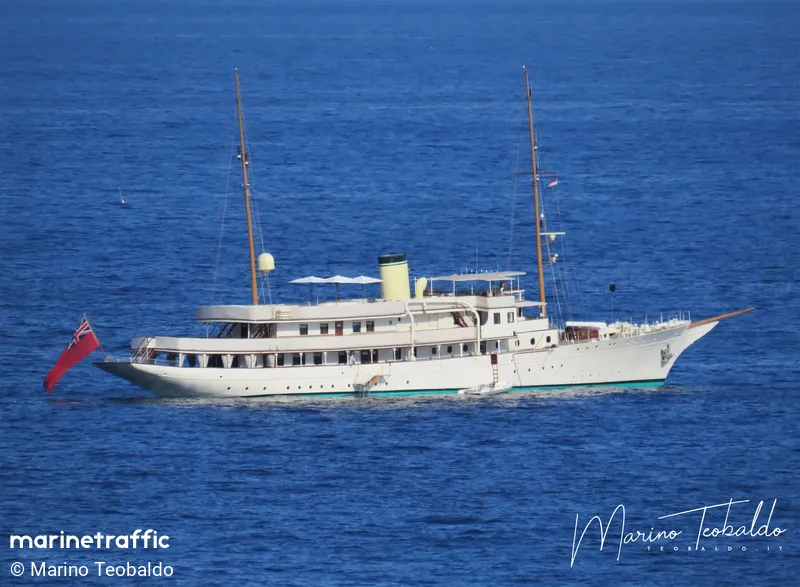
This report is from CelebYachts, which tracks the superyachts of public figures.1
The motor yacht registered in George Town spends her months in the Tuamotu Archipelago. The gap between her legal address and her observed position reveals how flag state registration functions as a corporate holding structure rather than a geographic anchor.1
The motor yacht known as Haida 1929 carries a home port painted under her stern that places her in the Caribbean. The letters read GEORGE TOWN. Her actual position, recorded by automated identification system broadcasts, places her in the South Pacific. The gap between these two coordinates measures more than eight thousand nautical miles. A port of registry is a legal address and frequently nothing more. The Cayman Islands register provides a stable jurisdiction for vessels that spend their operational lives elsewhere.
The legal address
The Cayman Islands flag and the George Town home port appear in the vessel’s official record. The designation has survived multiple changes of ownership and several major refits. The register does not require the hull to visit Grand Cayman, nor does it restrict where the vessel may operate. This arrangement allows owners to maintain a consistent legal framework while moving the yacht across different maritime jurisdictions. The administrative convenience of a single flag appeals to operators who charter Historic vessels across multiple regions. The paper trail remains fixed in George Town while the steel moves through international waters. The registry office processes applications based on documentation rather than physical inspection of the hull’s location. This separation between legal domicile and actual position is standard practice for vessels of this age and size.1
The South Pacific loop
Automated identification system data shows Haida 1929 operating continuously within French Polynesia during August 2026. The vessel was last observed at latitude 16.47° south, longitude 151.73° west. Her movements form a tight circuit around the Society Islands and the Tuamotu Archipelago. On 5 August she logged a passage of 17 nautical miles near Bora-Bora, averaging 2.4 knots. Six days later she completed a 39 nautical mile transit around Vaitape with an average speed of 10.5 knots. Between 7 and 8 August she covered 82 nautical miles off Tikehau, maintaining an average of 11.0 knots. A longer leg followed on 16 August, carrying her 211 nautical miles from Rangiroa to Moorea at an average speed of 9.9 knots. The final tracked movement occurred on 17 August, covering 13 nautical miles around Papeete at 6.8 knots. These passages indicate routine cruising between populated islands and sheltered lagoons. The distances are short relative to open ocean crossings, which suits the shallow draft of the hull. The AIS track confirms she has not approached the Atlantic basin or the Mediterranean during this period. The legal port of George Town exerts no influence on these routing decisions. Hydrodynamics and charter demand do.1
The Germaniawerft hull
The steel that forms Haida 1929 was cut at Friedrich Krupp Germaniawerft in Kiel. The keel was laid in 1927 and the vessel launched the following year. The design came from the New York firm Cox & Stevens, who specified a length of 66.7 metres and a beam of 9.1 metres. The original displacement measured 693 gross register tons. Max C. Fleischmann commissioned the yacht as his private cruiser. He was the younger son of Charles Fleischmann, founder of the Cincinnati yeast company. When his brother Julius died in 1925, Max assumed management control of the enterprise. He did not relocate from California and declined further executive duties in 1929, dedicating himself instead to marine science and fishing. The yacht was named for the Haida people, whose seafaring skills impressed him. She was delivered via New York and the Panama Canal to the Santa Barbara Yacht Club, where Fleischmann had donated funds for a breakwater.1
The United States Navy acquired the vessel on 25 October 1940 from Mrs. Max C. Fleischmann. The Craig Shipbuilding Company converted her at Long Beach and renamed her Argus. She was commissioned on 13 February 1941 and assigned to patrol San Francisco Bay. In September 1941 she was transferred to the United States Coast and Geodetic Survey and renamed Pioneer. Executive Order 9072 returned her to the Navy on 16 March 1942 after reconversion at General Engineering & Drydock Company. During her wartime service she rescued sixty survivors from the torpedoed Liberty ship John A. Johnson on 30 October 1944. She also established a weather station on Clipperton Island in December 1944 before decommissioning on 15 April 1946. The yard that built her, Friedrich Krupp Germaniawerft, was one of the largest builders of U-boats for the Kaiserliche Marine in World War I and the Kriegsmarine in World War II. Founded in 1867, the facility shifted between warship construction and civilian projects throughout the twentieth century. The conversion of Haida into a patrol vessel required stripping out the original accommodation and installing Military communications and armament mounts. The structural integrity of the hull allowed it to withstand repeated naval refits and decades of commercial operation.1
After the war the yacht entered a long sequence of private ownerships. An Egyptian cotton magnate purchased her in late 1946, renaming her Sarina and basing her at the Alexandria Yacht Club. Following the exile of King Farouk in 1952, she moved to Cannes. An American motor trader owned her briefly in the late 1960s before former British Member of Parliament Loel Guinness bought her in 1969. He restored her annually and cruised the Mediterranean. Australian entrepreneur Robert Stigwood acquired her in 1979, adding satellite communications concealed in a false funnel. An American art collector subsequently renamed her Rosenkavalier. Japanese property developers purchased her in 1988, overseeing a major refit in Thailand in 1991. Greek-Cypriot charter operator Andreas Liveras took possession the following year. A Swiss businessman bought her in 1999, restoring the original Krupp diesel engines in France and Turkey. She changed hands again in 2011 as Dona Amelia before undergoing an extensive refit at Pendennis Shipyard in Falmouth between 2016 and 2017. The yard returned her to service as Haida 1929 with an assessed tonnage of 720 gross register tons.1
The weight of steel
The physical dimensions of Haida 1929 dictate her operational envelope. The current length measures 66.41 metres with a beam of 10.6 metres. The draft stands at 3.5 metres, a constraint that limits access to shallow coastal waters but permits passage through the majority of Tuamotu atoll passes. She retains her original pair of Krupp diesel engines, producing a combined 1,500 horsepower. This power drives twin propellers and generates a top speed of 14.5 knots. The machinery layout occupies the lower decks, leaving the upper volume available for passenger accommodation. The beam width determines stability in open water but requires careful navigation in narrow channels. The hull form, designed for blue water cruising in the 1920s, remains seaworthy enough for modern charter operations. The Cayman Islands flag registers the vessel for legal purposes, but the steel and the engines determine where she can sail. The AIS data reflects those mechanical realities, not the administrative convenience of a Caribbean port.1
Read this on celebyachts.com, where the figures are checked against the live register.1