Read the original on CelebYachts →


This report is from CelebYachts, which tracks the superyachts of public figures.1
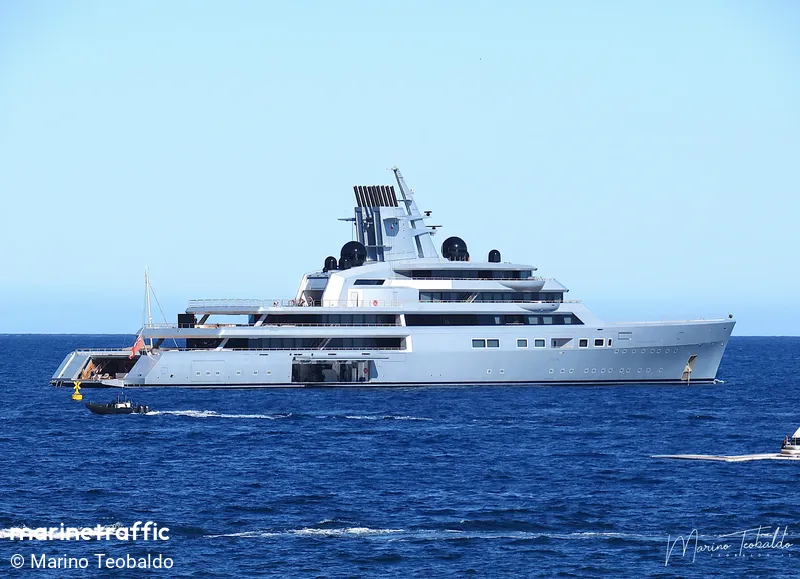
The 142-metre motor yacht was commissioned by a Russian gas executive as Project Alibaba before changing hands to a Silicon Valley founder during construction. The sale price remains undisclosed, but the engineering and financial mechanics of the transaction explain why the vessel arrived in December 2024 with a new name and a different owner.1
Dragonfly measures 142.15 metres in length with a beam of 20.42 metres and encloses 9,408 gross tonnes. She carries the Cayman Islands flag and is registered out of George Town. The vessel sits at number thirteen on the list of motor yachts by length. Her current owner is Sergey Brin, an American computer scientist whose wealth derives from his role as a controlling shareholder and board member of Alphabet Inc. The hull was originally commissioned by Leonid Mikhelson, a Russian industrialist, under the working title Project Alibaba. Construction began in 2019 and the keel was laid in 2020. During the build phase, ownership transferred from Mikhelson to Brin. The commercial terms of that transfer have never been published. The estimated cost of the completed vessel stands at $450 million.1
The commission and the transfer
Transferring a superyacht mid-construction is rarely driven by aesthetic disagreement. It is almost always a response to liquidity requirements, regulatory pressure, or corporate restructuring. When a buyer steps in after the keel is laid, the shipyard does not restart the drawing office. The naval architecture, the structural plans, and the machinery specifications remain locked to the original contract. This constraint forces the incoming owner to accept a finished layout rather than dictate a new one. Dragonfly reflects that compromise. The exteriors were designed by German Frers and the interiors by Nauta Design. The hull is steel and the superstructure is aluminium. Five decks provide 2,000 square metres of living space. Twelve cabins accommodate twenty-four guests, and the accommodation plan allows for a crew of fifty-three. No public photographs exist of the interior. The vessel was launched in December 2023 and delivered on 3 December 2024.1
The yard and the hull
The transfer of Project Alibaba into the Dragonfly registry illustrates how superyacht accounting handles unfinished assets. A vessel under construction represents a significant capital commitment for both the builder and the original client. When the original client exits the deal, the shipyard requires immediate confirmation of funding to continue laying steel and installing systems. Lürssen, the Bremen-based yard that constructed Dragonfly, is the largest private yacht builder in the world. The yard maintains multiple facilities across northern Germany, including sites in Lemwerder, Rendsburg, Wolgast, Hamburg, and Bremen-Fähr-Lobbendorf. Its scale allows it to absorb mid-build transfers without halting production lines. The yard delivered Dragonfly less than 12 months after launch, indicating that the incoming owner cleared any outstanding balances required to trigger final outfitting and sea trials.1
The renaming of the hull from Project Alibaba to Dragonfly marks the point where Brin assumed operational control. The change does not imply a redesign. It simply signals the moment the new owner took delivery of the keys. The vessel’s registration details confirm the shift: she now carries the IMO identifier 9907196 and the MMSI code 319296900. Her home port is recorded as George Town.1
Power and presence
The engineering package installed during the build phase dictates how Dragonfly operates today. She runs on a diesel-electric hybrid propulsion system capable of reaching 24 knots. Two MAN diesel engines, each producing 7,300 kilowatts or 9,789 horsepower, drive an electric azimuth pod system. The hybrid arrangement was chosen to manage noise and vibration while providing efficient cruising speeds. The vessel’s electrical infrastructure is substantial. Even when stationary, the hotel load system must run continuously to power HVAC units, lighting, galleys, laundry facilities, elevators, stabilisers, water management equipment, and entertainment systems. The daily electrical consumption at dock reaches approximately 16,800 kilowatt-hours. That volume matches the baseline power draw of a small cruise ship.1
Recent AIS broadcasts place Dragonfly in the western Mediterranean. Between 2 August and 11 August 2026, she operated out of the Balearic Islands. She made multiple short hops between Mahón, Palma de Mallorca, and Ibiza. One passage covered 66 nautical miles from Mahón to Palma at an average speed of 11.5 knots. Another leg ran from Fiumicino to a point 79 nautical miles off Palma de Mallorca, covering 381 nautical miles at 16.8 knots average speed. The maximum recorded speed during these movements was 18.2 knots, well below her 24-knot top speed. The pattern suggests routine testing and familiarisation rather than long-distance transit.1
The arrival of Dragonfly in the fleet coincided with recognition from industry bodies. She won the Superyards over 80m category at the Yacht Style Awards in 2025 and was listed as a finalist for Yacht of the Year at the World Yacht Trophies later that same year. These accolades reflect the completion of the build cycle and the successful integration of the German Frers exterior and Nauta Design interior packages. They do not indicate a change in ownership structure. The vessel’s current configuration remains exactly what was specified when Mikhelson signed the initial contract.1
The financial architecture behind Dragonfly continues to operate through opaque holding structures. Brin controls his wealth via Alphabet Inc., which he co-founded with Larry Page. He stepped down as president of Alphabet in 2019 but retains voting control and board influence. In December 2025, following a California billionaire tax initiative, Brin and Page terminated or moved 60 limited liability companies that held their assets out of the state. That corporate restructuring demonstrates the kind of legal agility required to manage multi-billion-dollar personal fortunes, but it does not directly explain the Dragonfly transfer. The specific mechanism that moved the hull from Mikhelson to Brin remains outside public records. What is visible is the result: a 142-metre vessel built for one owner, delivered to another, operating on a fixed engineering platform, and sailing under a new name in international waters.1
Read this on celebyachts.com, where the figures are checked against the live register.1