The ninety-four-metre compromise

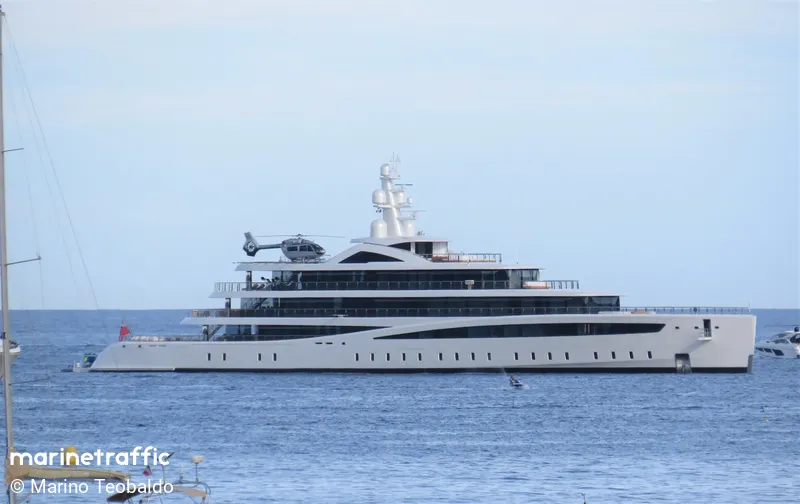
This report is from CelebYachts, which tracks the superyachts of public figures.1
Hull 817 was delivered in 2021 at exactly ninety-four metres. Its dimensions reveal a deliberate calculation by the Dutch cooperative to prioritise slipway throughput over gross tonnage, a trade-off that suits an owner whose capital originates from high-frequency trading rather than long-haul shipping.1
Feadship operates as a cooperative venture between Royal Van Lent Shipyard and Koninklijke De Vries Scheepsbouw, sharing a single design and engineering centre at De Voogt Naval Architects in Hoofddorp. The arrangement splits construction across four locations: two yards owned by De Vries in Aalsmeer and Makkum, and two operated by Royal Van Lent in Amsterdam and on the island of Kaag. Makkum provides deep-water access for vessels exceeding one hundred and twenty metres, housing a one hundred and seventy-metre construction shed and a massive dry dock. Amsterdam opened a new dock in early 2019 capable of handling up to one hundred and sixty metres. VIVA was constructed at the Kaag facility, which maintains two dry docks and two slipways specifically sized for yachts up to one hundred metres in length. The yard averages two launches per year.1
The cooperative yield
The decision to build VIVA at Kaag rather than Amsterdam or Makkum dictated the hull’s proportions. The Kaag slipways are rated for one hundred metres, which places a hard ceiling on the project’s maximum allowable length. Ninety-four metres sits comfortably within that envelope, leaving room for structural reinforcement and fitting-out work without requiring a transfer to a larger shed. The yard’s limited infrastructure means it cannot absorb the delays that frequently plague longer projects at other European facilities. Owners who select this location accept a fixed dimensional boundary in exchange for a predictable handover date. The cooperative structure itself traces back to 1949, when naval architect Henri de Voogt founded the association to sell steel-hulled yachts to American clients, shifting away from wood construction by the mid-1950s. The company officially debuted at the 1951 New York Boat Show. Don Kenniston served as Feadship America’s first general manager from 1977 until 2008, after which Ted McCumber took over the Americas office. In September 2025, the cooperative joined the Nuclear Energy Maritime Organization, signalling a shift in long-term engineering priorities.1
The volume constraint
A ninety-four-metre hull typically displaces between three thousand five hundred and four thousand gross tonnes when fitted with standard luxury accommodations. VIVA registers at two thousand nine hundred and ninety-nine gross tonnes. The difference amounts to nearly six hundred tonnes of empty space, a gap that corresponds directly to the fourteen-metre beam. Contemporary American-owned motor yachts in the same length bracket routinely carry beams approaching eighteen metres, which expands deck area and allows for deeper tankage and larger guest suites. The narrower profile of VIVA reduces internal volume and limits the footprint available for amenities such as swimming pools or expansive sun decks. The design foregoes breadth to maintain a lower resistance coefficient, a configuration that aligns with the vessel’s observed operating pattern. The cooperative’s engineering centre manages these trade-offs centrally, ensuring that reductions in beam do not compromise classification requirements. LVMH acquired Royal Van Lent in 2008, bringing additional capital to the design process, while both parent companies received royal charters upon their centenaries in 2001 and 2006 respectively.1
The coastal circuit
AIS tracking confirms that VIVA does not operate on transatlantic routes. Between late July and early August 2026, the yacht completed two passages along the French Riviera. The first ran from Nice to Saint-Tropez, covering thirty nautical miles at a maximum speed of fifteen point six knots and an average of twelve point one knots. The second followed a similar trajectory from Saint-Tropez to Antibes, logging twenty-nine nautical miles with a peak of fourteen point seven knots and an average of eleven point nine knots. Both legs achieved one hundred percent AIS coverage. These distances match the operational radius of a coastal cruiser. The vessel remains anchored in the Ligurian Sea, positioned at forty-three point two nine degrees north and six point six five degrees east. The narrow beam and reduced tonnage produce a hull form that accelerates quickly over short distances but offers less stability for extended ocean crossings. The home port is listed as Bloody Bay, yet all tracked movements remain confined to the western Mediterranean.1
The capital cycle
Ken Griffin acquired the vessel in 2021. His wealth derives from Citadel LLC, a hedge fund he established in Chicago in 1990 with four point six million dollars in seed capital. Griffin started at Glenwood Capital Investments in 1989, made seventy percent in a year, and moved to Chicago to found his own firm. He graduated from Harvard College in 1989 with a Bachelor of Arts degree in economics. During his studies, he bought put options on Home Shopping Network for five thousand dollars and secured a Merrill Lynch brokerage account with one hundred thousand dollars from personal contacts. His first fund launched in 1987, profiting from short positions on Black Monday. The firm grew into a multinational operation managing approximately sixty-seven billion dollars in assets by early 2026, generating roughly ninety point four billion dollars in net gains after fees since inception. Griffin holds an eighty percent stake in the fund and also owns Citadel Securities, a market maker that reported profits of two point three six billion dollars in the first half of 2020 alone.1
The scale of these returns explains the estimated two hundred and fifty million dollar valuation placed on VIVA, though the actual transaction price has never been confirmed. The capital required to purchase the hull flows directly from quarterly distribution cycles rather than asset sales or private equity exits. In November 2020, Bloomberg News reported that Griffin’s net worth surpassed twenty billion dollars due to an increase in the value of Citadel. As of January 2026, estimates place his wealth between twenty-two point seven billion and fifty-one point two billion dollars. The firm faced criticism during the 2008 financial crisis when Griffin barred investors from withdrawing money for ten months, and again in January 2022 regarding its role in the GameStop short squeeze, when it invested two billion dollars into Melvin Capital. Despite regulatory scrutiny, the fund delivered a thirty-eight point one percent return on its flagship Wellington fund in 2022, generating a record sixteen billion dollars in profits for investors.1
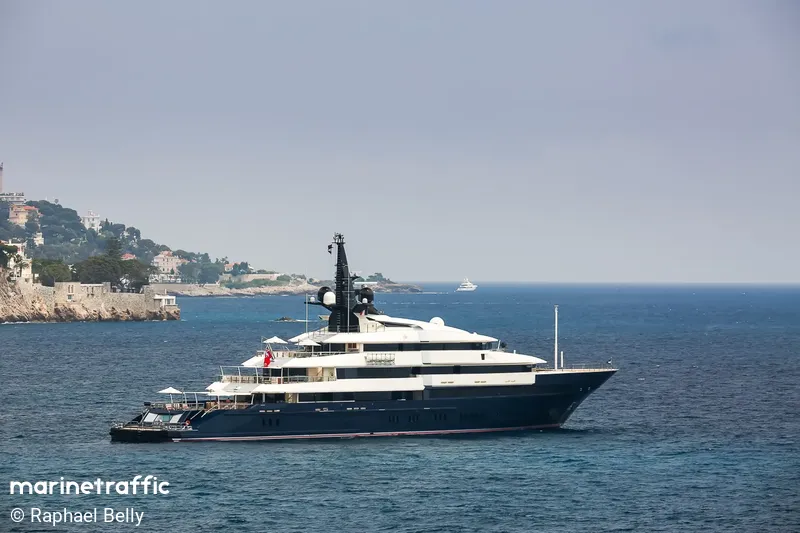
VIVA flies the Cayman Islands flag and lists her home port as Bloody Bay. Her IMO identifier is 9798246 and her MMSI is 319179500. She falls into the category of United States tycoons, financiers and sports owners. No other hull in the current register shares her exact combination of builder, length, beam and gross tonnage. The nineteen photographs held by the site show a clean superstructure line and a stern layout consistent with the reduced beam. AIS data shows no movement outside the Mediterranean basin since the summer of 2026. The vessel occupies a niche that balances Dutch engineering standards with the operational habits of a trader who prefers short, frequent departures over long-range cruising.1
Read this on celebyachts.com, where the figures are checked against the live register.1
Sources
Every number in the story points here. Each links to the original reporting.
Not ratedCelebYachts
See a sentence its source doesn’t back up?
Tell us the source number and what’s wrong. We check every report. If we change the story, the fix goes on the corrections page with the old wording.