Read the original on CelebYachts →

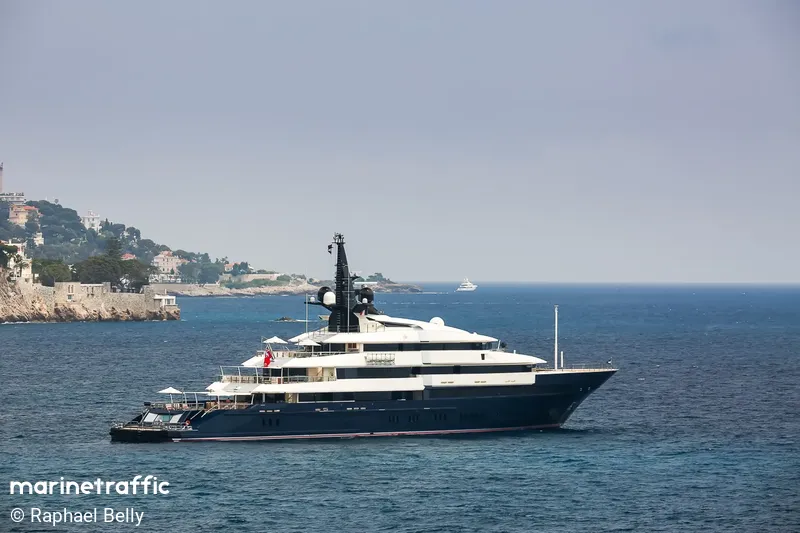
This report is from CelebYachts, which tracks the superyachts of public figures.1
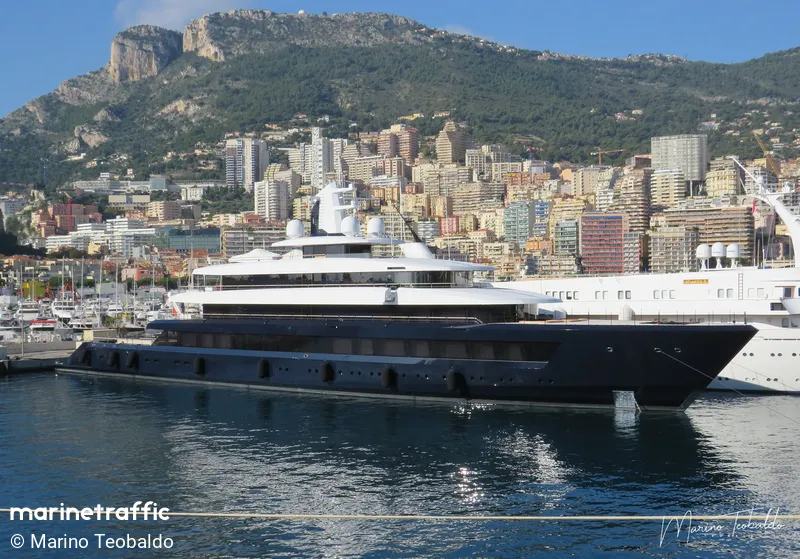
The 86-metre Oceanco carries 2,658 tons of gross register, a density that forces a specific architectural solution. With the interior designer’s brief withheld, the Steel itself explains what the owner demanded.1
The interior layout of Man of Steel has never been published. No floor plan, no material specification, and no record of the initial brief survives in open sources. That silence is standard for a vessel of this age and ownership tier, and it ends the moment one stops guessing at marble finishes and looks at the registered figures instead. Gross tonnage measures the total enclosed volume of a ship, counting every habitable space above the waterline. Man of Steel registers 2,658 tons against an overall length of 86.01 metres. This produces a ratio of 31 tons per metre of hull. In superyacht architecture, a figure of this magnitude on an 86-metre platform requires a superstructure that extends well beyond the main deck. It implies a full upper deck, a substantial sky lounge, and generous ceiling heights across the principal social areas. The naval architect, Nuvolari & Lenard, achieved this volume by maximising the vertical stack while keeping the waterline length restrained. Extending length adds drag and displacement, whereas increasing height and breadth multiplies interior volume.1
The beam as a spatial lever
A 14.2-metre beam reinforces that volumetric strategy. Man of Steel sits at a length-to-beam ratio of 6.05, a proportion that favours broad, pillarless spans across the main salon and dining areas. The extra width dictates the placement of staircases and lift shafts, which must be routed through the centreline or tucked into the aft superstructure to preserve the full-width social decks below. Classification rules for escape routes and watertight subdivision take a fixed share of that internal volume, leaving the remainder for accommodation. On a vessel of this tonnage, the machinery space alone occupies a significant portion of the lower hull, meaning the living quarters are stacked vertically rather than spread horizontally. The wide beam also improves transverse stability, allowing the interior layout to utilise open-plan configurations without compromising safety margins during heavy weather.1
The register lists her hull type as motor, confirming a conventional powertrain rather than hybrid or sail-assisted systems. Full-displacement motor yachts of this era rely on heavy Steel construction and large fuel reserves to achieve intercontinental range. The machinery space therefore consumes a predictable percentage of the lower hull volume, leaving the upper decks to absorb the remaining gross tonnage. This architectural trade-off explains why the interior volume scales with beam and deck height rather than length. Naval architects designing within these parameters accept that corridor widths and cabin layouts must conform to the fixed footprint of the propulsion plant. The result is a functional interior where social spaces occupy the widest available sections, while service areas and technical compartments are compressed into the narrower aft and forward sections.1
The Alblasserdam production schedule
Oceanco delivered Man of Steel in November 2010, a period when the Alblasserdam yard was executing a deliberate shift in production capacity. The company had acquired adjacent land in 2008 and spent 2010 demolishing its original slips to construct a new covered dry dock capable of handling vessels up to 140 m. Man of Steel entered that facility during the final phase of its construction, benefiting from the yard’s ability to run parallel build programmes without weather delays. The yard operates across 8.2 ha with almost unrestricted direct access via the inland waterway system to the North Sea. This logistical setup allows Oceanco to maintain a throughput of approximately two custom superyachts per year, with the capacity to simultaneously construct five hulls in the 80-metre-plus category. Interior contractors working under such timelines typically prioritise durable, low-maintenance finishes over bespoke artisanal work, as the pressure to meet sea-trial dates leaves little room for iterative design changes. The resulting interiors tend towards clean lines and robust material palettes, a practical compromise that aligns with the operational demands of long-range cruising.1
Oceanco was founded in 1987 by South African investors led by Richard Hein, initially building hulls and superstructures in Durban before transporting them to the Netherlands for finishing. Theodore Angelopoulos took control in 2002, shifting the company’s focus to the 80-metre-plus niche market and launching the Y Generation series. Mohammed Al Barwani acquired the yard in March 2010, appointing Marcel Onkenhout as chief Executive. Man of Steel arrived at Alblasserdam shortly after Al Barwani’s takeover, succeeding Sunrays, an 85-metre vessel delivered in March 2010 with an interior by Terence Disdale. The proximity of these deliveries highlights the yard’s accelerated ramp-up phase. The new covered dry dock, completed during 2010, replaced the original slipways and enabled concurrent construction cycles. This infrastructure upgrade reduced exposure to seasonal weather disruptions, compressing the fit-out window and forcing interior teams to sequence their work around fixed mechanical installation milestones.1
Capital, flag, and operational tempo
The capital that funded the hull traces back to Barry Zekelman, a Canadian Steel Executive born in December 1946. His reported net worth stands at $3.6 billion, accumulated through decades of leadership in the Steel sector and related commercial ventures. Ownership of an 86-metre custom motor yacht represents a fraction of his liquid assets, yet the procurement process still follows the same discipline as any major industrial acquisition. The buyer defines the envelope—length, speed, range, and tonnage—and the yard fills it within commercial and regulatory limits. What the owner specifically requested inside those walls remains undisclosed, but the external dimensions reveal the boundaries of that request. Her home port is George Town in the Cayman Islands, a flag choice that aligns with standard maritime tax structures for vessels of this value. International classification societies base their survey requirements on the vessel’s actual dimensions and intended use, so the 2,658 gross tonne rating triggers standard safety inspections without imposing additional structural mandates that would alter the original interior layout.1
Automated Identification System broadcasts place her stationary at 41.25° N, 9.44° E, in the Tyrrhenian Sea off the coast of Sardinia. Her movement profile over the preceding week shows coastal hops between the French Riviera and Italy, covering distances between 18.8 and 949.5 nautical miles at average speeds of 8.4 to 14.8 knots. These passages indicate a varied operational tempo, consistent with a full-displacement hull optimised for fuel efficiency rather than high-speed transit. The propulsion plant is clearly tuned for sustained fuel efficiency, a configuration that deliberately sacrifices top-end velocity to enlarge the machinery space footprint and preserve interior volume elsewhere. The 16.8-knot bursts recorded during brief accelerations remain well below the 20-knot threshold typical of semi-displacement luxury cruisers, further indicating that the owner valued quiet operation and extended range over speed. Her current stationary position suggests she is conducting routine maintenance or awaiting crew rotation, a common pause in the operational calendar for yachts of this age.1
Read this on celebyachts.com, where the figures are checked against the live register.1