Read the original on CelebYachts →
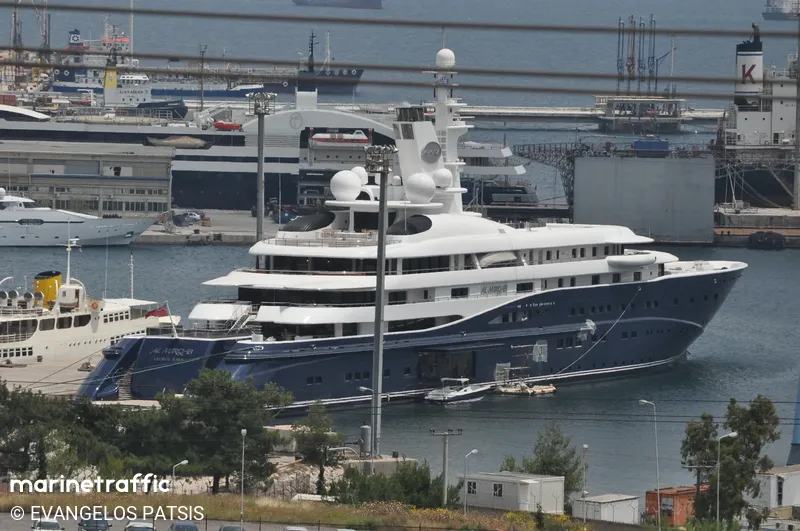
This report is from CelebYachts, which tracks the superyachts of public figures.1
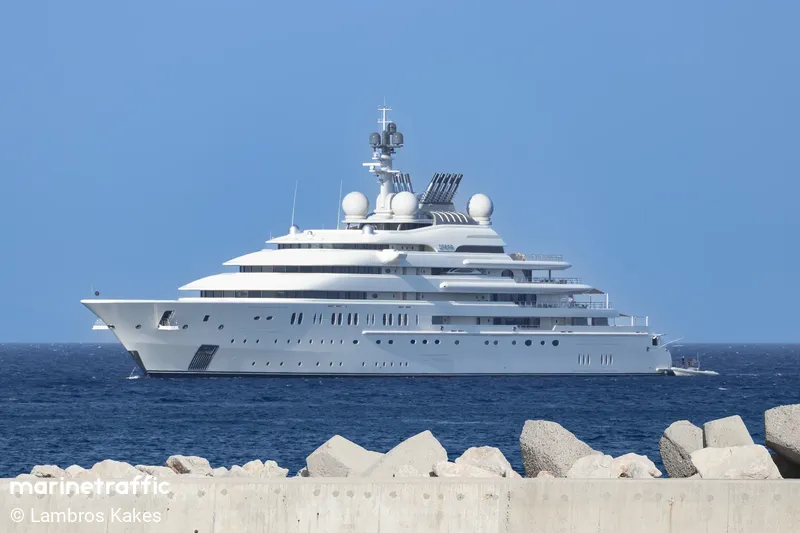
Al Mirqab carries the dual stamp of Peters Schiffbau and Kusch Yachts. Her dimensions and gross tonnage show a specific industrial arrangement rather than a bespoke commission. The interior has not been published; the steel tells a different story about capacity and constraint.1
The builder field reads Peters Schiffbau / Kusch Yachts, a notation that marks a specific moment in European shipyard consolidation. Peters and Kusch operated as separate German firms before merging their production capabilities and transferring tooling between their Rostock and Travemünde facilities. Al Mirqab was launched in 2008, sitting exactly within the window when those two organisations were harmonising their slipway schedules and supply chains. The hull measures 133.2 metres in length and carries a gross tonnage of 9,518. Those two figures establish the spatial parameters of the vessel more reliably than any marketing material ever could.1
Dividing the length by the beam yields a ratio of roughly 6.4 to 1. A beam of 20.87 metres on a hull of this length produces fine entry lines and a relatively narrow waterplane area forward. Naval architects select that proportion to reduce wave-making resistance at higher speeds. The trade-off appears directly in the interior volume. A ninety-five-hundred-tonne allocation across one hundred and thirty-three metres of length leaves a linear density of approximately seventy-one tonnes per metre. That figure sits below the modern average for luxury motor yachts exceeding one hundred metres, which typically push past eighty tonnes per metre when owners prioritise expansive salons and multiple guest suites. The hullform therefore favours hydrodynamic efficiency over volumetric generosity. A narrower beam also constrains the placement of stabiliser fins, which must be housed within the hull sides or tucked beneath the keel, further reducing available tankage or storage space below the waterline.1
The specific layout of the cabins, the materials selected for the joinery, and the placement of the main salon have never been published. The owner has kept the floor plans private. What remains visible in the specification table is the structural envelope. A beam of 20.87 metres dictates the maximum width of any single room below the weather deck. Side corridors would consume nearly half of that span, leaving a central core for the principal living spaces. The low gross tonnage relative to the length suggests a lower freeboard than contemporary designs, which reduces windage and keeps the centre of gravity down, but it also restricts the vertical stacking of decks. Every cubic metre of interior space had to be accounted for against that 9,518 GT ceiling.1
The yard merger and the hull form
The register does not list shaft horsepower or fuel capacity, but the operational track confirms the power plant’s character. Al Mirqab spent August 2026 moving between French Riviera ports under AIS tracking. The recorded passage from Antibes to Cannes covered 17 nautical miles at an average speed of 9.1 knots, with a peak of 13.8 knots logged during the transit. Those figures rule out a design optimised for sustained high-speed dashes. The propulsion system was clearly tuned for economical cruising and smooth sea-keeping rather than sprint performance. A vessel built to cross oceans at twenty knots would show those speeds in her broadcast data. Instead, she operates in the nine-to-fourteen-knot band, which aligns with a displacement hull form carrying nearly ten thousand tonnes. The low average speed also indicates a conservative engine management strategy, likely programmed to minimise fuel consumption and acoustic signature during coastal navigation.1
The beam sets the limits for the upper works. A twenty-metre-plus width allows for a full-width helicopter landing pad amidships, provided the support structures are integrated into the superframe. The absence of published technical drawings means the exact location of the aviation deck cannot be confirmed, but the proportions make an aft or midship configuration equally plausible. Tender storage follows the same geometric logic. The beam accommodates a large garage door without compromising the side deck width required for crew access and safety railings. Classification rules for passenger craft dictate minimum escape routes and watertight bulkhead spacing. Those regulations consume a fixed percentage of the internal volume, leaving the remainder for the owner’s accommodation. The 9,518 GT cap forces a tight balance between statutory requirements and usable space.1
The machinery envelope and deck layout
The registered owner is Sheikh Hamad bin Jassim bin Jaber Al Thani, who served as prime minister of Qatar until 2013. His wealth derives from the sovereign endowments established by the ruling Al Thani family, which control the emirate’s hydrocarbon revenues and foreign investment portfolios. The acquisition of a 133-metre superyacht in 2008 coincides with a period of expanded Gulf state capital deployment into European maritime assets. The vessel serves as a mobile residence and a diplomatic platform. The choice of a Cayman Islands flag and George Town as home port reflects standard practice for holders of Middle Eastern state wealth. Cayman registration provides a neutral jurisdiction for charter operations and liability limitation, while George Town offers a well-established registry office and a time zone aligned with European banking hours.1
Al Mirqab flies the Cayman Islands flag today. Her last recorded position placed her at 43.71° N, 7.35° E in the Ligurian Sea. The AIS transmitter remained active through late summer 2026, showing routine coastal movements rather than long-distance ocean passages. The vessel spends her time in the western Mediterranean, operating between the French and Italian coasts. The combination of her hull form, her cruising speeds, and her flag selection points to a design philosophy centred on stability, privacy, and low-profile operation. She does not require shallow drafts for Caribbean anchorage, nor does she carry the exaggerated superstructures common on newer builds. The steel was cut for endurance and discretion.1
The owner’s footprint and operational pattern
Read this on celebyachts.com, where the figures are checked against the live register.1