Read the original on CelebYachts →

This report is from CelebYachts, which tracks the superyachts of public figures.1
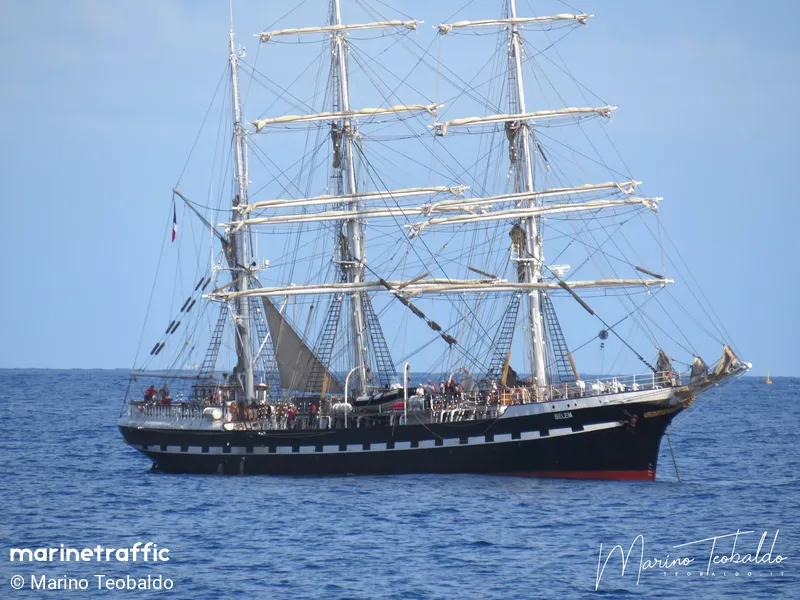
Belem, a 58-metre barque launched at Chantiers Dubigeon in 1896, remains registered to the second Duke of Westminster. Tracing her current legal standing requires following the inheritance of British landed wealth rather than tracing shell corporations. The AIS data shows her moving slowly along the Norwegian coast, but the steel belongs to a title that survived eighteen million pounds in post-war taxation.1
The ownership structure of Belem does not follow the modern pattern of offshore holding companies or layered trusts. She is recorded directly against the name of Hugh Richard Arthur Grosvenor, second Duke of Westminster, and her continued presence on the register reflects the mechanics of British landed inheritance rather than contemporary maritime finance. A vessel of this age and tonnage rarely changes hands through commercial channels once it enters a noble lineage. The legal mechanism that keeps her attached to the Grosvenor name is the entailed estate, the payment of heavy death duties, and the subsequent transfer of titles through collateral lines.1
The French registry and the Nantes slipway
Belem was built at Chantiers Dubigeon in Nantes and launched in 1896 as a sailing hull. Her dimensions are fixed at 58.0 metres in length and 8.8 metres in beam. The gross tonnage sits at 507. She carries the flag of France and lists Marseilles as her home port. The IMO identifier is 8622983 and the MMSI is 227051000. These registration details place her firmly within the Historic and legacy yacht category, yet they also raise a straightforward question about jurisdiction. A British Duke owning a French-flagged vessel implies a transfer of registry that occurred long after her initial construction. The register does not record the date of that flag change, nor does it document any intermediate purchasers between the original builders and the Grosvenor family. The absence of those records means the corporate architecture is irrelevant; the asset has remained within a single bloodline for over a century.1
The AIS track confirms she is active but operating at low speeds consistent with coastal transit or yard work rather than open-water cruising. Her position hovers off the Norwegian coast, moving between established ports in Rogaland and Hordaland counties. The data shows a series of short hops, each leg covered at an average speed between 3.7 and 5.8 knots. This operational profile matches the maintenance cycles of large Historic vessels that require frequent dry-docking or hull inspections. The steel itself does not move quickly because the priority is preservation, not passage. The ownership structure supports this pace. An estate that pays eighteen million pounds in death duties does not liquidate assets to fund rapid voyages. It maintains them.1
The mechanics of the Grosvenor inheritance
Hugh Richard Arthur Grosvenor was born on 19 March 1879 and died on 19 July 1953. His wealth originated from landownership in Britain, specifically the Westminster estate centred around Eaton Hall in Cheshire. He held the title of second Duke of Westminster and served as both military personnel and politician. The register lists him as the owner, which places the acquisition of Belem within his lifetime. Historical accounts note his support for Nazi ideology and his relationship with the French designer Coco Chanel, but neither detail alters the legal chain of title. The relevant fact is the source of the capital that purchased the hull. Landed wealth provided the liquidity, and the entailment rules dictated how that wealth would survive his death.1
The financial pressure on the Grosvenor estate arrived immediately after the second Duke’s death. His estate attracted then-record death duties of £18,000,000. The Inland Revenue required the full amount to be paid over a period spanning from July 1953 to August 1964. This fourteen-year settlement window forced the estate to manage its assets carefully. Large vessels like Belem do not generate income, so they remain on the books as part of the broader property portfolio until the tax liabilities are cleared. The register does not show a sale during this period, which indicates the estate retained her while liquidating other holdings or drawing on reserves to meet the annual instalments.1
Succession followed the strictures of the entail. The second Duke left no surviving sons; his only son, Edward George Hugh Grosvenor, Earl Grosvenor, died aged four in 1909 after an operation for appendicitis. Consequently, the titles and the entailed Westminster estate passed to his cousin, William Grosvenor. The line continued through the two sons of the youngest half-uncle, Lord Hugh Grosvenor, who had been killed in action in 1914. The dukedom transferred again in 2016 to Hugh Grosvenor, seventh Duke of Westminster. Each transition required probate proceedings and updated registration filings with the relevant maritime authorities. The AIS data shows the same IMO number flying the same French flag, which proves the administrative continuity across three separate decades of succession.1
The Norwegian coastal circuit
The voyage log for August 2026 provides a precise view of how the estate operates the vessel today. The tracking coverage is complete across eight distinct legs, all executed at low speeds. The sequence begins on 28 July when she moved from Farsund in Agder to Stavanger in Rogaland, covering 21.1 nautical miles at an average of 5.5 knots. She remained in the Stavanger area for two days, making a 14.0-nautical-mile loop on 29 July at 5.0 knots average, before departing for Haugesund on 31 July. That crossing took 36.2 nautical miles and averaged 5.8 knots. The next day she proceeded to Stord, a distance of 94.1 nautical miles completed over approximately twenty-five hours at 3.7 knots average. The slower pace on the longer run suggests engine management or weather routing rather than mechanical limitation.1
Once at Stord, the vessel performed a tight local circuit. On 1 August she made a 10.2-nautical-mile run back to Stord at 4.1 knots. The following day she repeated a similar pattern, covering 10.2 nautical miles in roughly three hours at 4.1 knots average. On 3 August she departed Stord for Bergen, a distance of 35.2 nautical miles completed in seven hours at 5.3 knots average. The final recorded movement on 4 August was a brief 11.6-nautical-mile excursion out of Bergen and back, averaging 3.9 knots. Every leg achieved 100 percent AIS coverage, meaning the transmitter was active throughout each passage. The distances are too short for blue-water transit and too regular for random anchoring. They match the schedule of a vessel undergoing survey, refit, or seasonal preparation in the Norwegian shipyard cluster.1
The combination of the French flag, the British owner, and the Norwegian operational base illustrates how Historic yachts function outside standard commercial models. There is no shipping company managing charters or freight. There is no leasing agreement transferring usage rights to a third party. The vessel exists as a fixed asset within a larger landed estate, maintained according to preservation standards rather than revenue targets. The AIS tracks her movements, the register ties her to a specific individual, and the inheritance laws dictate her future. When the current holder dies, the same probate process will repeat. The steel will remain tied to the Grosvenor name, the French registry will stay unchanged unless a formal de-registration occurs, and the Norwegian waters will continue to host her during the summer months. The structure is simple because it has survived by being simple.1
Read this on celebyachts.com, where the figures are checked against the live register.1